Foundations
From Prompts to Harness: Building Agentic Systems That Ship Without Breaking
Prompts tell an agent what to do; a harness enforces what must happen.
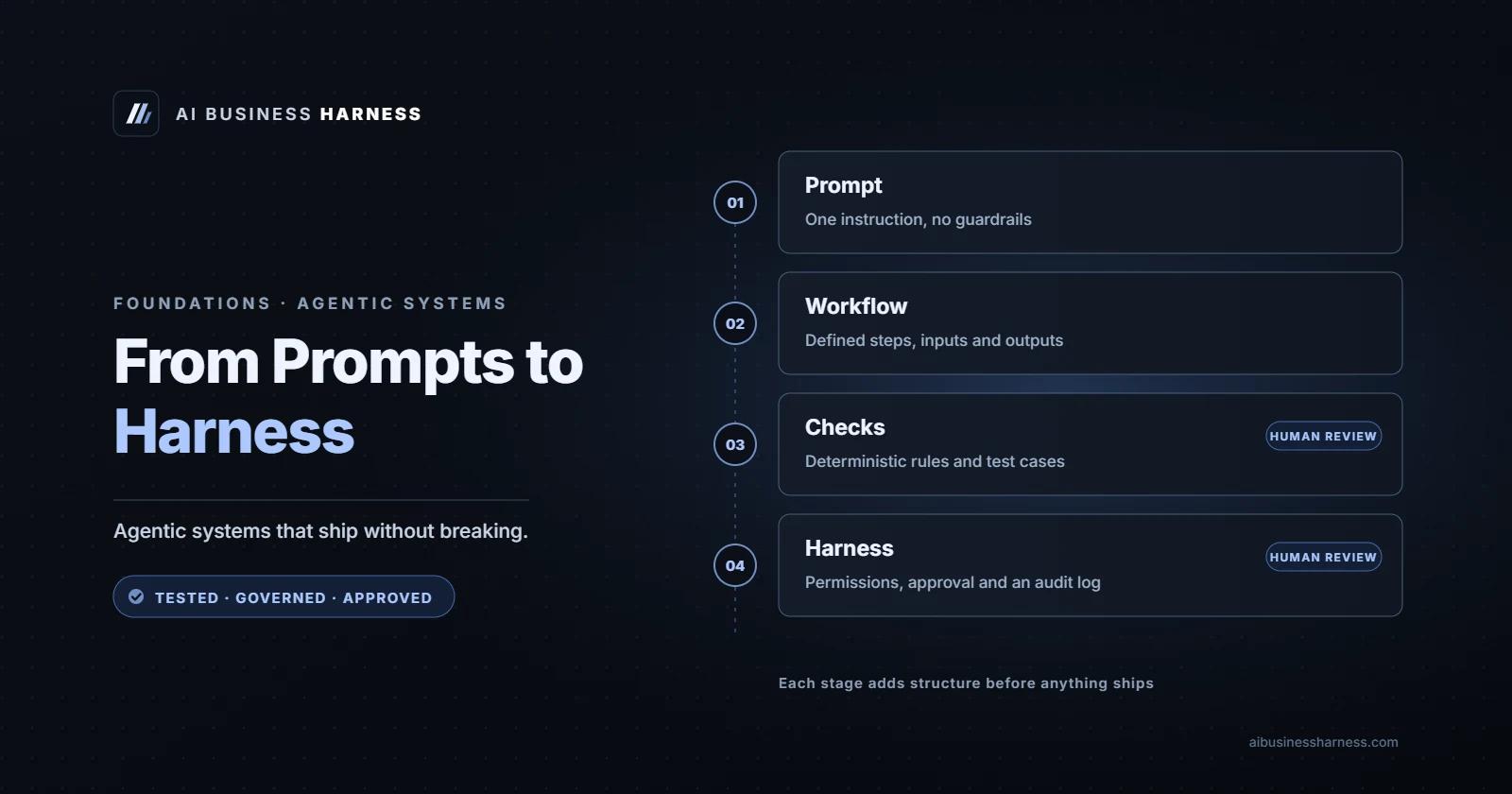
If you have spent any time trying to get AI coding agents or operational workflows to run autonomously, you already know the frustration: an agent writes brilliant code or generates clever text nine times out of ten, and on the tenth time it breaks a core assumption, touches an unauthorized file, or invents a pricing structure that doesn't exist.
The industry response has often been to chase better prompts or newer models. But as recent engineering frameworks from practitioners like Addy Osmani demonstrate, prompts tell an agent what to do; a harness enforces what must happen.
Quick answer: Building reliable AI systems requires moving away from unguided prompt-chasing and toward an agent harness architecture. By enforcing strict specification gates, scoped permissions, automated verification, independent review, and human-approved releases, businesses can deploy AI workflows that operate safely, produce verifiable evidence, and sharply reduce broken deployments.
Why unguided agents fail in production
Most small businesses and technical teams run into the same three walls when deploying AI:
- The Scope Creep Trap: An agent given broad access will attempt to solve a problem by modifying files, database tables, or configurations it has no business touching.
- The Self-Exemption Problem: When an agent encounters an error, unguided systems often allow the agent to rewrite its own tests or bypass failing checks to declare victory.
- The Black-Box Dilemma: Without a structured audit trail or verifiable evidence, you only discover a failure after a customer sees an unapproved message or a production script crashes.
Fixing these issues doesn't require waiting for a more powerful model. It requires an engineering harness that treats agent output as untrusted until proven otherwise.
The five-gate governance framework
To build a system that is auditable, controlled, and accountable, AI Business Harness enforces five mandatory gates across every operational workflow and code deployment:
1. Specification Gate
Purpose: Lock requirements before writing code or building workflows.
Enforcement rule: No implementation begins without documented requirements, acceptance criteria, and a defined scope.
2. Permission Gate
Purpose: Restrict agent access to the minimum required tools.
Enforcement rule: Agents receive only the permissions needed for their assigned tasks; enforcement policies remain strictly outside their control.
3. Automated Verification Gate
Purpose: Catch regressions and syntax errors programmatically.
Enforcement rule: Type checking, unit tests, and policy checks must pass before any change can be merged.
4. Independent Review Gate
Purpose: Separate execution from evaluation.
Enforcement rule: A separate reviewer evaluates changes, potential risks, and supporting evidence for unnecessary complexity.
5. Release Gate
Purpose: Protect production and customer-facing channels.
Enforcement rule: Production deployment requires recorded evidence, a rollback plan, and explicit human approval.
What happens when a check fails?
In a loose system, a failing test is treated as a nuisance to be patched over. In an engineering harness, every failure becomes a learning mechanism:
Every failure becomes a documented finding and a new test or rule, reviewed before it goes in.
When an agent violates a boundary or produces an invalid proposal during simulation, the failure is isolated into a written finding. That finding becomes a proposed automated test or strict policy rule, which must be reviewed and approved by a person before being added to the repository's permanent guardrails.
People also ask: AI harness engineering
What is the difference between an AI model, an AI agent, and an AI harness?
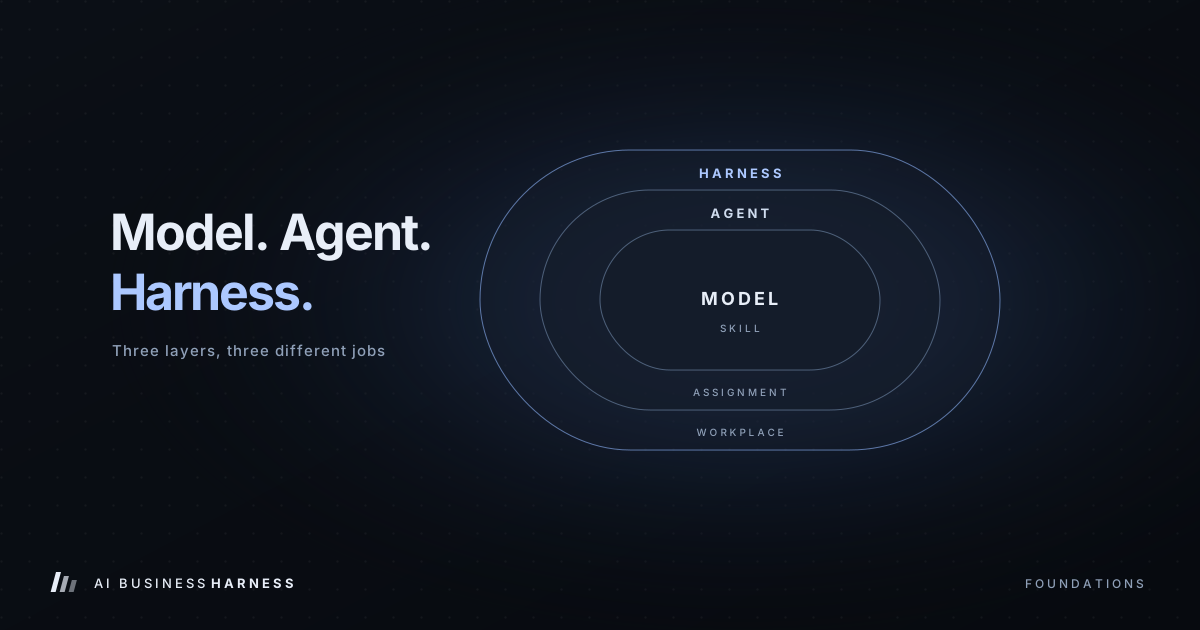
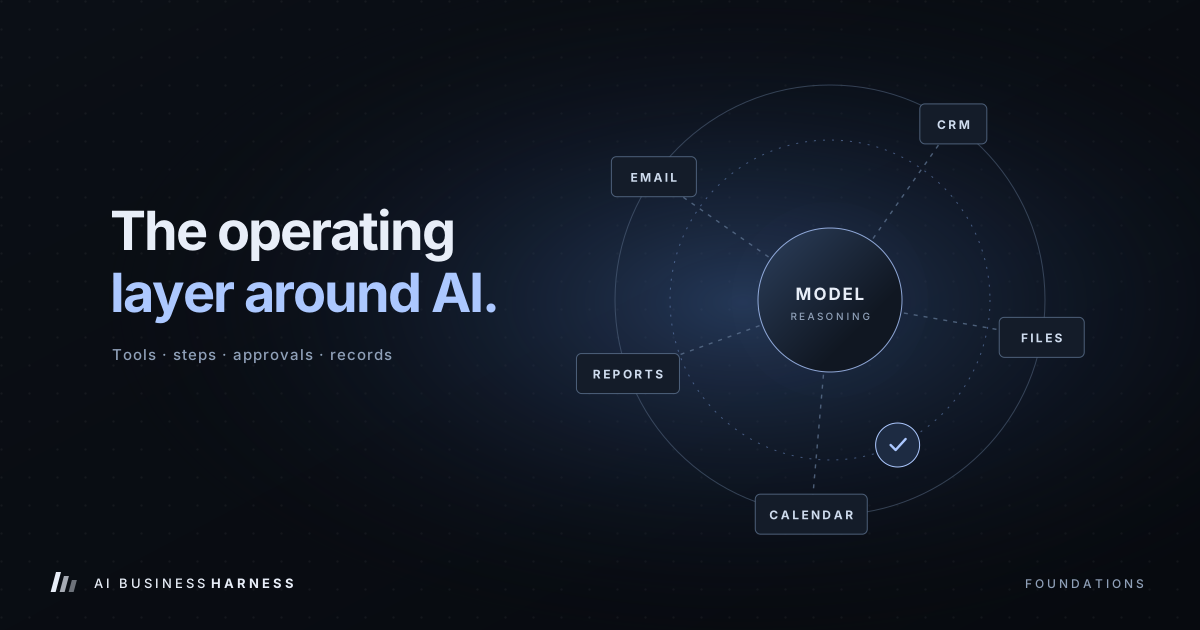
An AI model is the underlying engine that interprets text and predicts the next token. An AI agent uses the model to pursue a goal across multiple steps. An AI harness is the surrounding control system—containing permissions, APIs, validation logic, and approval gates—that restricts what the model can access, verifies its work, and records what happened.
Can an AI agent execute customer-facing actions without human approval?
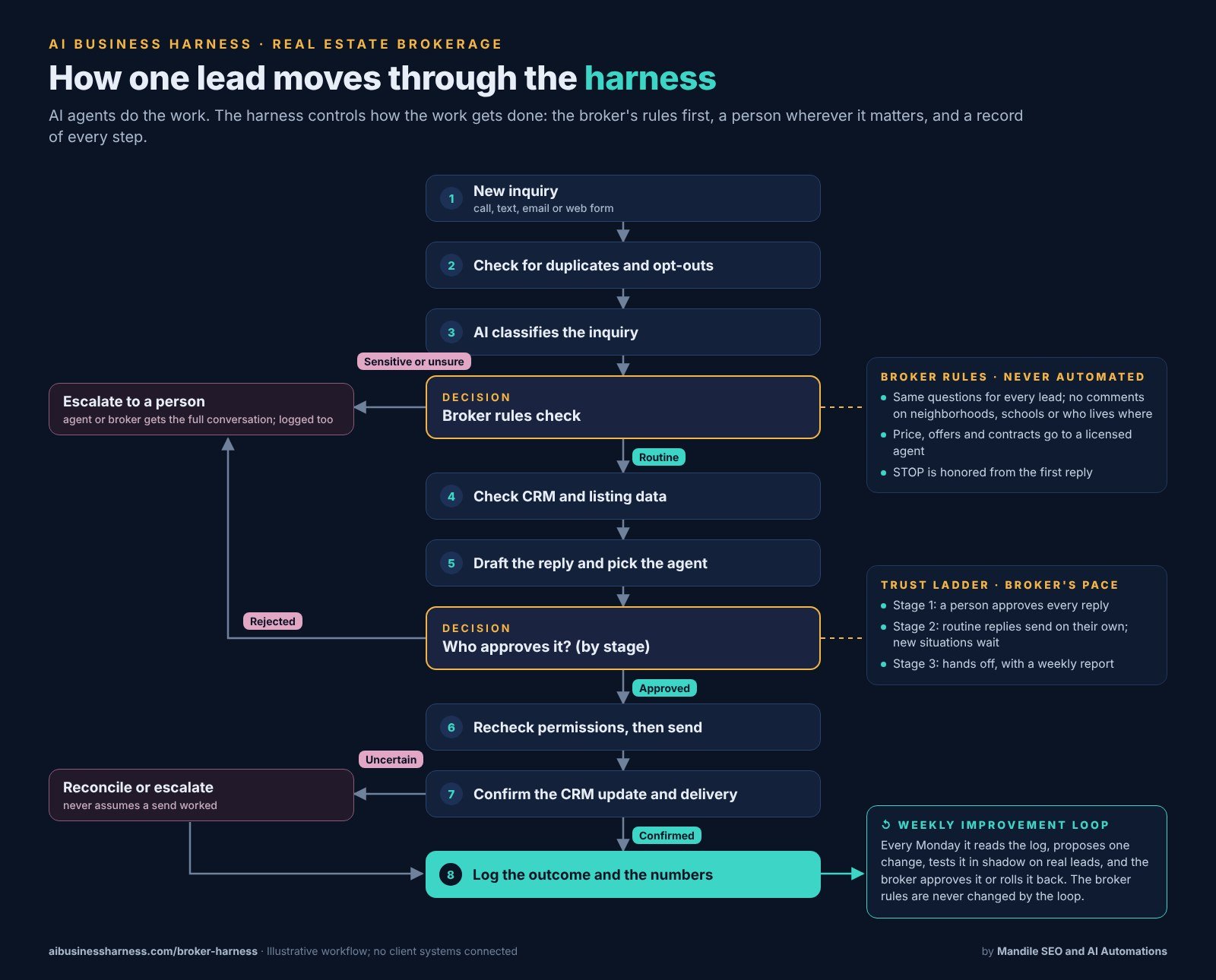
Not under a properly configured harness. In business workflows such as Estimate Follow-Up, customer-facing messages and discounts are held in Stage 1 review; the model drafts options and internal notes, but nothing is sent until a human operator explicitly approves it.
Why are hard permission rules external to the agent?
If an agent controls the rules governing its own execution, it can circumvent them when facing a difficult task. Keeping permission policies and validation checks entirely outside the agent's modification scope prevents self-exemption and maintains system integrity.
Ready to secure your workflows?
Practical AI isn't about giving an agent the keys to everything. It's about building a focused operating system where every workflow has a purpose, strict permissions, and a human decision point when it matters.
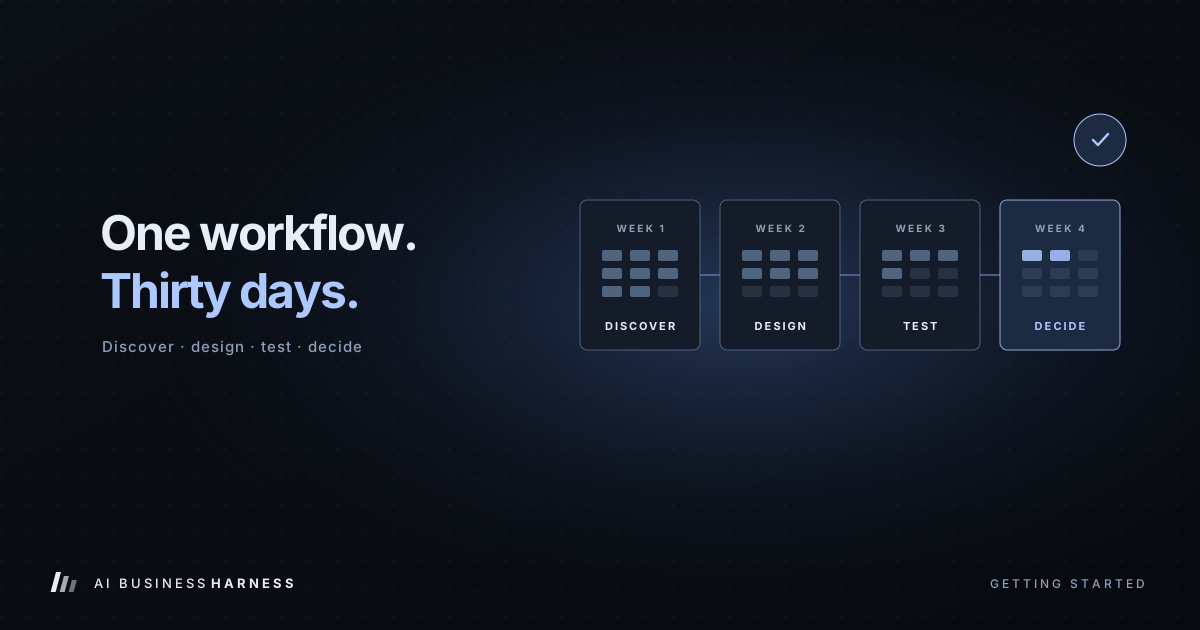
Explore our structured solutions, including the 30-Day Installation and Estimate Follow-Up workflow, or review our foundational guides on AI Business Harness architecture.