Getting started
The 30-Day Installation: A Week-by-Week Plan for Small Businesses
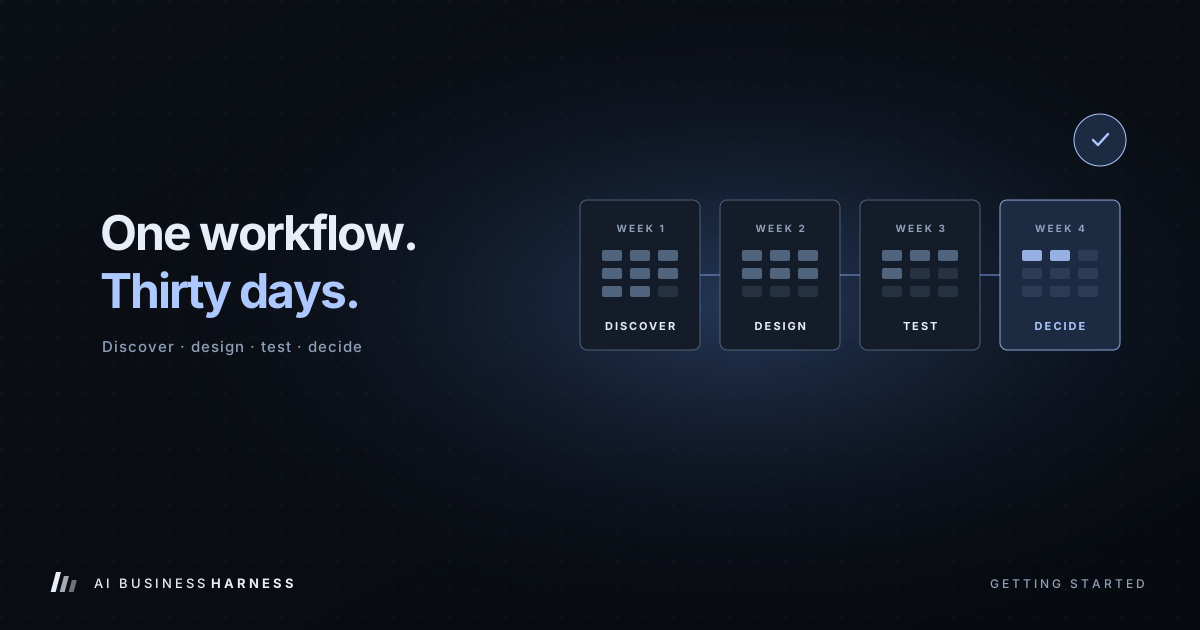
You don't need a six-month AI transformation. You need one workflow, tested properly, in thirty days. Here's the week-by-week plan.
Big AI transformation projects tend to stall. They try to change too much at once, they're hard to measure, and by the time anything ships, the team has lost interest.
A better approach is a tightly scoped 30-Day Installation: one workflow, one measurable problem, thirty days. At the end, you have evidence, and a clear decision about whether to keep, change or stop.
Here's how to run one.
Before you start: set the rules
Agree on three things up front:
- One workflow only. Resist adding "while we're at it" items.
- A person approves anything customer-facing. No exceptions during the installation.
- A go/no-go review on day 30. Decided in advance, so the installation can't drift on indefinitely.
Week 1: Discover and measure
Goal: choose the workflow and understand how it works today.
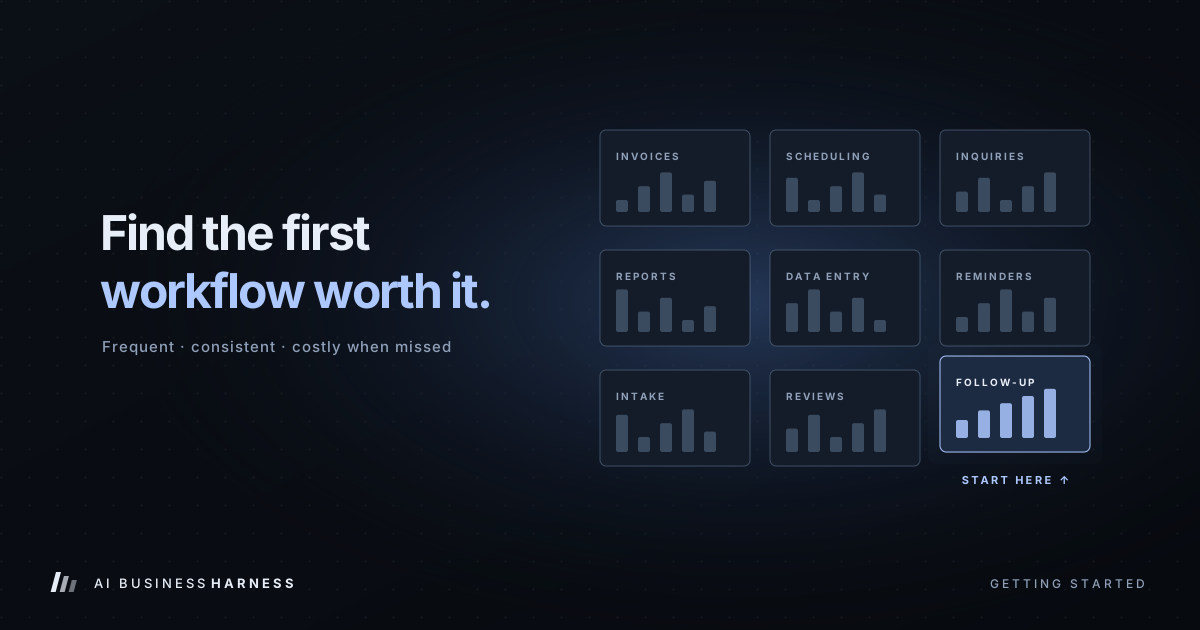
- List repetitive tasks and pick the strongest candidate: frequent, consistent, costly when missed, easy to verify. (Our guide on finding the right workflow to automate walks through a scoring method.)
- Write the finish line: "This task is done when..."
- Map the current steps, people and tools involved.
- Record a baseline. How often does it happen? How long does each take? How often is it late or missed?
- Identify which systems hold the data and what access the workflow would need.
End of week check: a one-page description of the workflow, its baseline numbers and its finish line.
Week 2: Design and connect
Goal: build the workflow in a safe, controlled form.
- Design the steps: what triggers it, what it looks up, what it decides, what it prepares.
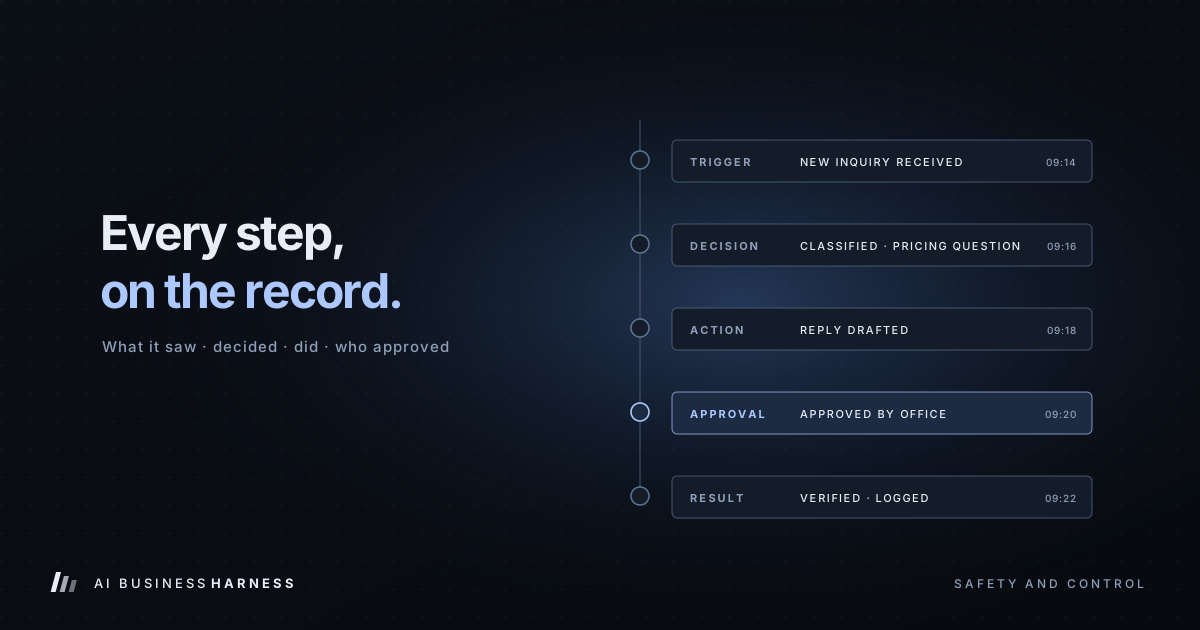
- Sort every action into tiers: runs automatically, needs approval, or off-limits.
- Set up the narrowest possible access: read-only where possible, drafts instead of sending.
- Write down your voice and rules: example replies, things to never say, when to escalate.
- Decide what gets logged and where exceptions go.
End of week check: the workflow runs end to end on sample data, with nothing connected to live customer communication.
Week 3: Test with real, but controlled, work
Goal: run it on real inputs while a person reviews everything.
- Turn it on against live data with all customer-facing actions held for approval.
- Review every output. Approve, edit or reject, and note the reason for edits and rejections.
- Fix issues as they appear: missed cases, wrong classifications, tone problems.
- Watch the exception queue. What the workflow can't handle is as informative as what it can.
End of week check: a list of issues found and fixed, and early numbers on approval and edit rates.
Week 4: Measure and decide
Goal: compare against the baseline and make a decision.
Gather the numbers:
- How many times did the workflow run?
- What share of outputs were approved with no edits? With light edits? Rejected?
- How much time did review take, compared with doing the task by hand?
- Did anything get missed that wouldn't have been before, or vice versa?
- What happened to the outcome you cared about: response time, follow-up coverage, errors?
Then make the call:
- Keep and expand: results are good, review is fast, the team trusts it. Plan the next step, such as more message types or a related workflow.
- Keep and adjust: promising, but specific problems need another round of fixes.
- Stop: the workflow didn't earn its place. That's a valid, valuable result, and it cost thirty days, not a year.
What makes first installations fail
- Scope creep. Three half-built workflows are worth less than one finished one.
- No baseline. Without "before" numbers, every result is an opinion.
- Too much access too soon. Start narrow. Expand on evidence.
- Nobody owns review. Approvals that sit for days make the workflow look broken.
- Judging on day three. Early runs surface the fixable problems. Judge on the full month.
After the installation
A successful installation isn't the finish line. It's the foundation. The workflow now has a track record, a log and a person who trusts it. From there, you can move to managed operation: ongoing monitoring, regular review of exceptions, and gradual expansion based on what the data shows.
That's exactly the structure of the 30-Day Installation we run at AI Business Harness. If you have a repetitive task that's eating your team's time, tell us about it. We'll help you figure out whether it's a good fit.