AI Front Desk
How to Calculate What Missed Calls Cost Your Business
A practical missed-call calculation using your own call logs, booking assumptions, and average job value.
Quick answer
Multiply qualified missed calls by your own estimated booking rate, then multiply by average job value. The result is a gross revenue scenario, not lost profit or promised recovery. Start with phone logs, remove duplicate and irrelevant calls, and compare the estimate with what your team actually books.
A ringing phone is not yet a job. A missed call is not automatically lost revenue, either. The useful question is narrower: how much potential work might be sitting in unanswered inquiries that your business could realistically serve? A simple calculation makes that question discussable without pretending the answer is certain.
What is the missed-call revenue formula?
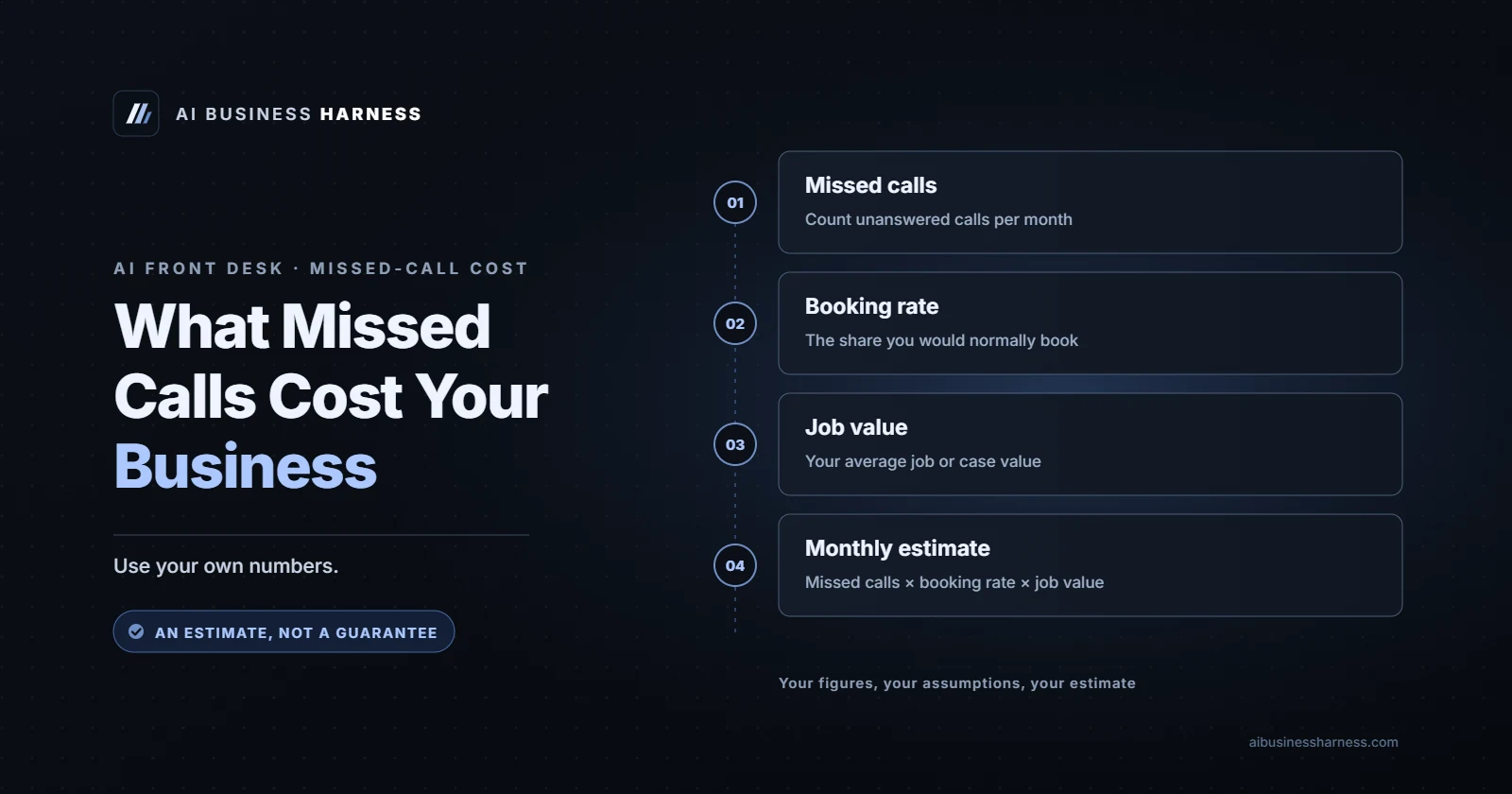
Use missed calls × your booking rate × average job value. Choose a consistent period, such as one complete month, and define each input before calculating. This estimates potential gross booked revenue under your assumptions. It does not show cash collected, margin, or the amount a new tool will recover.
Qualified missed inquiries × assumed booking rate × average job value = illustrative gross revenue opportunity
Use the booking rate as a decimal: 20% becomes 0.20. Keep the unrounded result for planning rather than rounding every partial job upward. An expected value of 2.4 jobs describes an average across comparable periods, not a promise that a fraction of a job can be sold.
Which missed calls should you count?
Count plausible new-work inquiries your team did not handle, including after-hours calls, weekend calls, and voicemails never returned. Then separate unique opportunities from repeat attempts. Existing-customer service questions, spam, wrong numbers, and work outside your service area belong in separate categories rather than inflating the revenue calculation.
- Include unanswered calls during working hours when everyone was occupied.
- Check evenings and weekends separately so your daytime average does not hide coverage gaps.
- Review voicemails with no documented callback or disposition.
- Group repeated attempts from the same caller about the same request.
- Mark unknown intent as unknown instead of assuming every silent caller wanted a quote.
A caller who later booked through your website should not also appear as a lost opportunity. Likewise, a callback that reached the customer but did not produce a booking is a different outcome from a voicemail nobody returned. Keep those distinctions in the worksheet.
How do you find the count in phone-system logs?
Open your phone provider's call history or reporting area and select a complete reporting period. Export the available call records, then filter inbound calls by missed, unanswered, abandoned, or voicemail status as your system defines them. Reconcile the result with callback notes before treating it as a list of opportunities.
Exact menu names differ by provider. Look for date and time, direction, caller identifier, destination line, duration, and disposition. Check whether a call transferred between extensions creates several rows. A short call may be spam or a customer hanging up; duration alone cannot settle which.
Use a restricted working sheet rather than copying customer details into a public calculator. Add columns for unique inquiry, likely service fit, callback completed, eventual booking, and unresolved status. If logs are incomplete, record the limitation and collect a cleaner baseline next month. An honest range is more useful than precise-looking arithmetic built on missing records.
Why must the booking rate come from you?
Your booking rate depends on service fit, available capacity, response time, and what you count as a booking. A published industry average cannot tell you how your missed callers would behave. Use your own comparable inquiries where possible, or label a low, middle, and high assumption when your records are limited.
Divide bookings by qualified inquiries from the same period and channel. Do not divide completed jobs by all phone calls and call that the same measure. A consultation, estimate appointment, signed engagement, and finished repair are different milestones. Choose one, name it, and use an average value that belongs to that milestone.
What does an illustrative example look like?
Illustrative example, not a client result: suppose a contractor identifies 40 unique, qualified missed inquiries in a month. The owner assumes that 20% would become booked jobs if handled appropriately, and uses $750 as average job value. The calculation is 40 × 0.20 × $750 = $6,000 in potential gross booked revenue.
| Input | Illustrative assumption |
|---|---|
| Qualified missed inquiries | 40 per month |
| Owner-selected booking rate | 20% |
| Average job value | $750 |
| Expected bookings | 8 |
| Gross scenario | $6,000 |
At a 10% booking assumption, the same inputs produce $3,000; at 30%, they produce $9,000. These are sensitivity checks, not forecasts. Labour, materials, cancellations, collection risk, and the cost of handling inquiries still matter. If your team has no capacity for additional work, improving intake may change organization rather than revenue.
How should you compare the opportunity with service costs?
Compare gross opportunity with full operating costs, not just a subscription. ABH setup is $3,500 Founding Client or $5,000 standard, followed by $1,500/mo managed or $5,000/mo Operations Partner. Scope and third-party usage need separate discussion. Keep one-time setup distinct from recurring costs rather than presenting gross revenue as net benefit.
Try the live calculators for plumbers and contractors or law firms, then check their inputs against your records. Read the AI front desk overview for service boundaries and the prompts-to-harness framework for the approval model. Stage 1 keeps outbound messages subject to owner approval.
For inquiries that have already reached the estimate stage, explore owner-approved estimate follow-up as a separate workflow.
Frequently asked questions
Is every missed call a lost sale?
No. Some calls are duplicates, spam, existing-customer requests, or inquiries you cannot serve. Count qualified opportunities separately and reconcile later bookings.
Should I include weekend calls?
Yes, if they concern work you could serve. Keep weekend and after-hours totals visible so you can assess coverage gaps.
What if I do not know my booking rate?
Use clearly labeled assumptions and show a range. Start tracking qualified inquiries and bookings so a later calculation can use your own evidence.
Does the calculation show profit?
No. It shows an assumed gross revenue opportunity before delivery costs, service fees, cancellations, and collection risk.
Can a calculator tell me what automation will recover?
No. A calculator explores assumptions. Recovery depends on caller intent, response quality, available capacity, and measured results after implementation.
Make the next decision from your own numbers
Bring a monthly call count, your booking definition, and an average job value. We can review the assumptions before discussing a scoped workflow. Book a Fit Call.
Source note: ABH industry pages and core architecture article linked above, checked November 7, 2026 (PST). All worked-example numbers are illustrative assumptions; no external benchmark is used.