Foundations
AI Model vs. AI Agent vs. AI Harness: What Business Owners Need to Know
Vendors use "model," "agent" and "harness" interchangeably. They aren't the same thing, and knowing the difference will save you from buying the wrong solution.
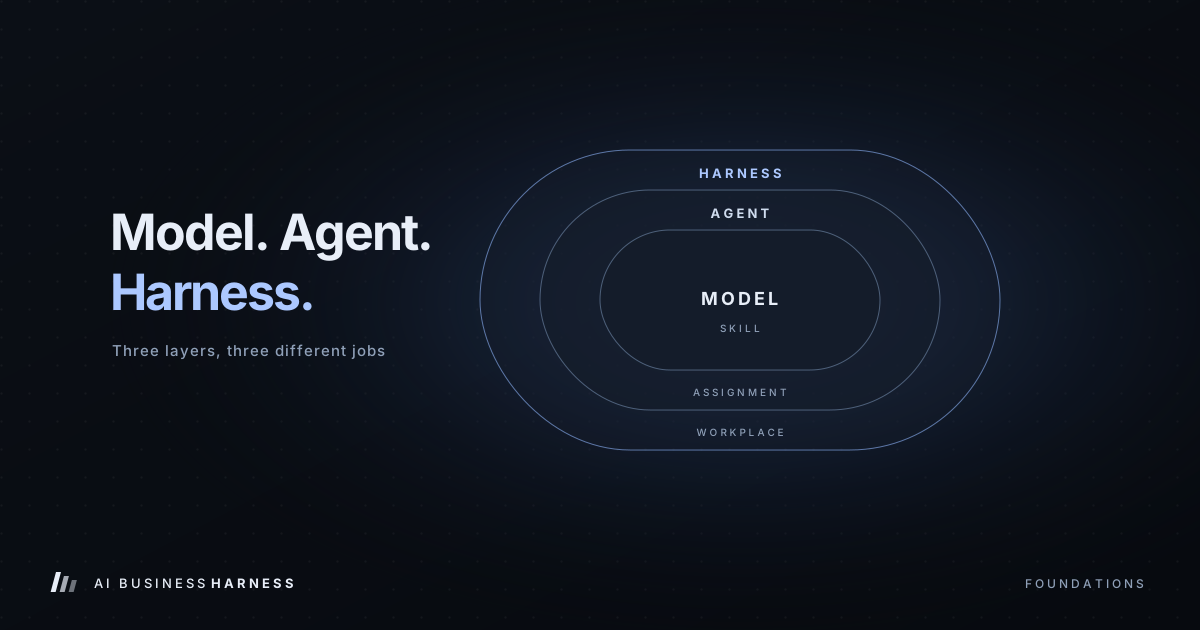
If you've sat through an AI sales pitch lately, you've probably heard "model," "agent" and "harness" used as if they mean the same thing. They don't. And the difference matters, because it's usually the least-discussed piece that decides whether an AI project survives contact with your actual business.
The three pieces in one sentence each
- The model is the engine that reads, reasons and writes.
- The agent is the model given a goal, instructions and tools, so it can take steps instead of just answering.
- The harness is everything around the agent that makes those steps safe, repeatable and accountable in a real business.
A kitchen analogy
Imagine a restaurant.
The model is a talented chef's skill: knowing how flavors work, how to read a recipe, how to improvise.
The agent is that chef assigned to tonight's service with an order ticket: "Make table six's entrées."
The harness is the kitchen itself: the stations, the ticket system, the rule that nothing leaves the pass until the head chef checks it, the prep list for tomorrow, the log of what was 86'd and why.
You can have a brilliant chef in a chaotic kitchen and still get cold food and missed orders. Most failed AI projects look exactly like that.
Side by side
| AI model | AI agent | AI harness | |
|---|---|---|---|
| What it is | The reasoning and language engine | A model working toward a goal with tools | The operating layer around the agent |
| What it's good at | Understanding, summarizing, drafting | Taking multi-step action | Control, consistency, accountability |
| What it lacks alone | Access to your systems, memory of your rules | Limits, approvals, verification, records | Nothing to run without a model and tasks |
| Business analogy | Skill | A worker on an assignment | The workplace, procedures and supervisor |
Why "just add an agent" often disappoints
Agents shine in demos because demos are clean: tidy sample data, one clear request, no interruptions. Real operations are messier:
- A customer record is duplicated or missing a phone number.
- The CRM is slow, or times out halfway through an update.
- Two similar requests should be handled differently because of a rule nobody wrote down.
- A task takes forty steps and the important instruction from step two gets buried.
Without a harness, each of those turns into a silent failure or an inconsistent result. With one, they become handled cases: validation catches the missing field, a retry handles the timeout, the rule is written into the workflow, and the active task stays in focus.
Questions to ask any AI vendor
When someone proposes an "AI agent" for your business, these questions tell you whether there's a real harness behind it:
- What exactly can it access? Ask for the list. "Everything" is the wrong answer.
- What can it do without a person approving it? You should be able to name every unattended action.
- How do you know a step worked? Listen for verification, not "the API returned 200."
- What happens when it fails? There should be an exception queue or alert, not silence.
- Where's the record? You should be able to see what it did, when, and why.
- How is my data kept separate from other clients'? Shared credentials are a red flag.
If the answers are vague, you're being sold a model with a nice interface, not a business system.
Which piece should you invest in?
Models improve and get cheaper on their own every few months, and you'll likely swap between them over time. The harness is where your business rules, permissions and history live. It's the part that's specific to you, and the part that keeps paying off when the model underneath changes.
That's why we start with the workflow, design the harness around it, and treat the model as a replaceable component. The result is AI that fits how your business already runs, instead of a business bent around a tool.
Further reading on the terminology: Microsoft Learn: Agent Harness, Databricks: What Is an AI Agent Harness?