Industry News
Microsoft Just Built an AI Harness for the Fortune 500. Here's the Version for Your Business.
Microsoft just made the harness, not the AI model, the center of how agents get work done. It built theirs for engineering teams. Here's the version for a 10-person shop.
On October 28, 2026, Microsoft launched the Copilot harness. It's the system that now runs AI agents across GitHub Copilot, Copilot Studio and VS Code, and it's open to developers through Microsoft Foundry.
If you own a local business, you probably skipped that headline. You shouldn't. When Microsoft builds a product around an idea, that idea is about to become the standard way work gets done. And the idea here is simple: AI only gets useful when you wrap it in a harness.
The catch is that Microsoft built theirs for enterprise engineering teams. Here's what a harness is, what Microsoft announced, and what the same thing looks like for a business with 5 to 50 people.
What an AI harness actually is
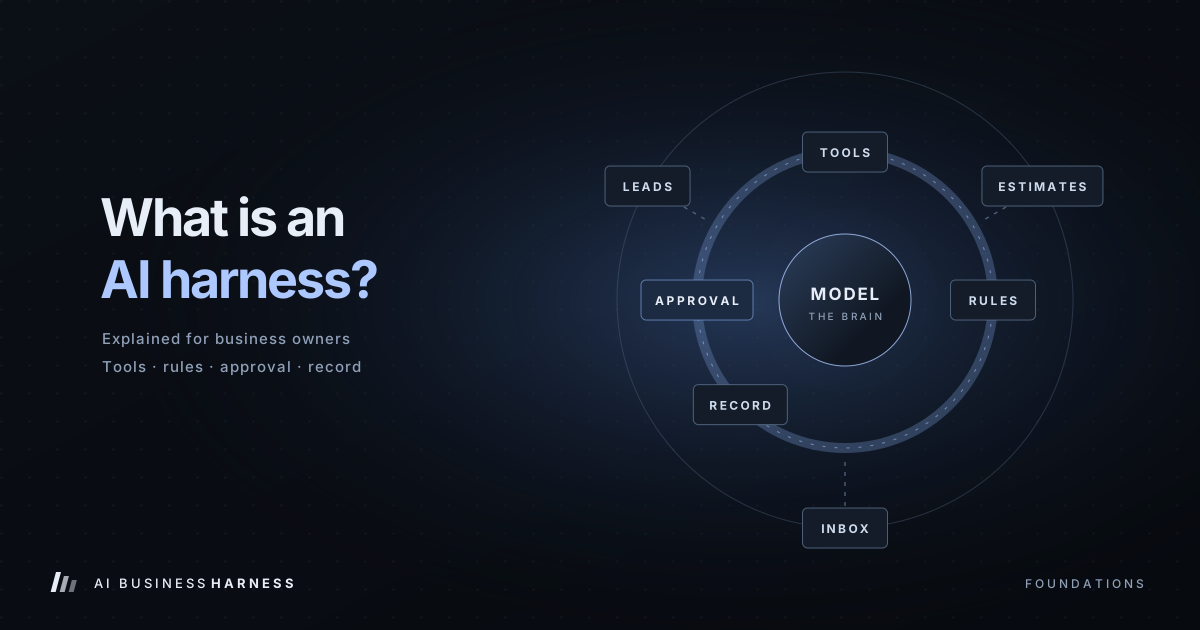
An AI harness is the software around a language model that turns its answers into controlled, multi-step work.
Think of the AI model as an engine. An engine on a stand makes a lot of noise and goes nowhere. To get anywhere you need the rest of the car: a transmission, a steering wheel, brakes and a dashboard. The harness is the rest of the car.
A working harness has four parts:
- Tools. Connections to the software you already use: email, calendar, CRM, your website, your phone system.
- Memory. Your prices, policies, past conversations and the rules for how your business runs, so the AI doesn't start from zero every time.
- A safe workspace. A sandbox where the agent does its work without touching anything it shouldn't.
- Guardrails. Rules that make the agent stop and ask a person before it sends, spends or deletes anything that matters.
Without a harness, a general-purpose AI assistant is a smart chatbot you copy and paste from. With one, it's a worker that finishes the job. Our plain-English guide to AI harnesses goes deeper on each part.
What Microsoft announced
GitHub's engineering team built the Copilot harness, and Microsoft now uses it across its Copilot products. According to Microsoft's announcement, the main points are:
- It works with many AI models. The harness supports more than 20 frontier models and sends each task to the model best suited to it.
- It uses open standards. It supports MCP, agent skills and plugins, the same building blocks that power other agent platforms.
- Microsoft runs the hard parts. It manages the agent loop, the sandbox and the governance. Developers bring the instructions, skills, tools and model choice.
- It's for developers. It's available as a managed service in Microsoft Foundry, with an open-source Copilot SDK on GitHub.
The biggest message isn't any single feature. It's that the AI model is only one part of the system. What surrounds the model decides what an agent can reliably get done. That's the same idea AI Business Harness is built on.
The open standards matter too. Skills and connectors are becoming a shared standard across vendors, so a workflow built for your business today isn't locked into one AI company.
Microsoft's harness vs. AI Business Harness
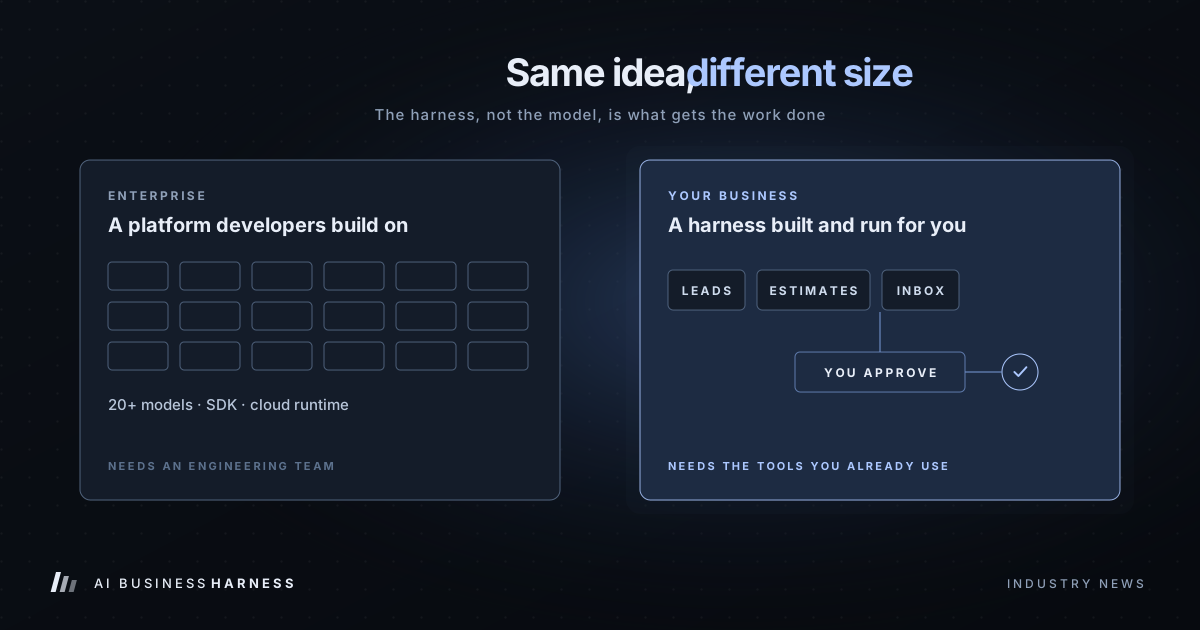
The two share the same architecture idea, but they do different jobs for different people.
| Microsoft Copilot harness | AI Business Harness | |
|---|---|---|
| What it is | The engine that runs AI agents | Business workflows, built and managed for you |
| Main job | Coordinates models, tools and skills | Connects your apps, records and daily processes |
| Who sets the rules | Developers, in code | You: approvals, exceptions and what AI may never do |
| How success is measured | How well the agent runs | Time saved, leads recovered, faster responses |
| Built for | Developers and enterprise teams | Owners of businesses with 5 to 50 people |
| What you need | Engineers and a cloud budget | The tools you already use and a person to approve |
Microsoft makes technology that a business system can be built on. AI Business Harness designs, builds and runs that business system for you.
A plumbing company doesn't want to buy an agent engine. It wants missed calls answered, customers followed up with, appointments booked and its CRM kept accurate. That's the layer we work in.
How the pieces stack up
Here's where each part sits, from the results you see at the top down to the AI models and software at the bottom.
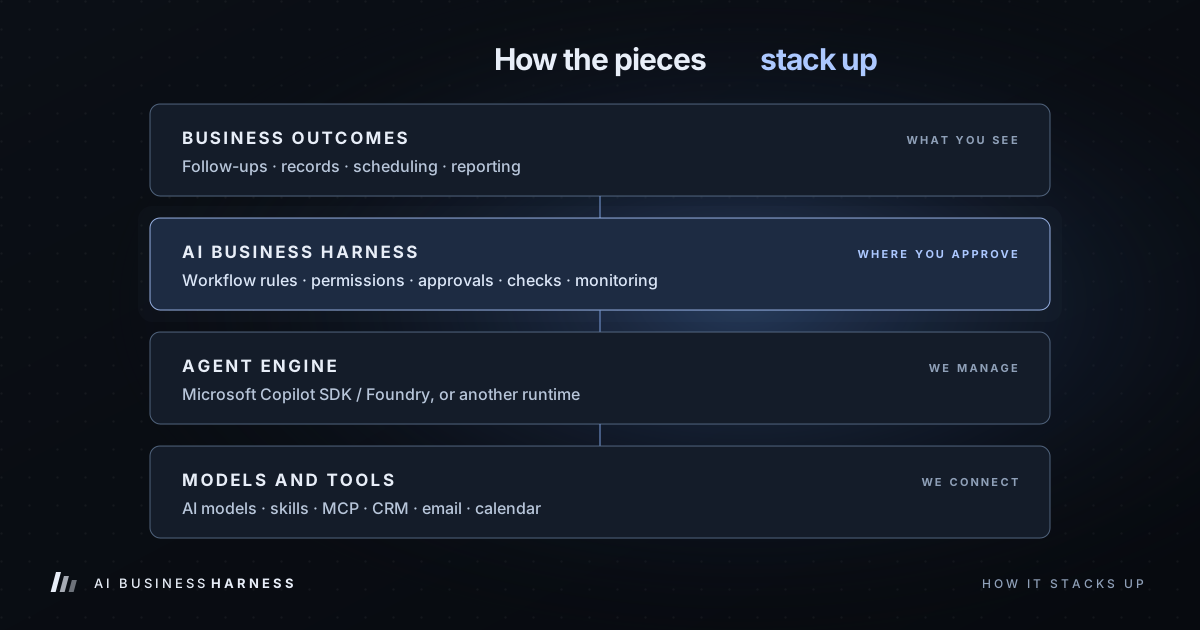
Your team only touches the top two layers: you see the results, and you approve what matters. The engine underneath can be Microsoft's or another one. We choose what fits each job, and you never have to manage it.
The gap: nobody builds this for a 10-person shop
Microsoft Foundry assumes you have developers, a cloud budget and time to learn a new platform. Most small business owners have none of those. They have a phone that rings during jobs, an inbox full of quotes to send, and a stack of follow-ups they meant to make last week.
What an owner needs isn't a developer platform. They need someone to:
- Find the work their team repeats every day.
- Pick one or two of those jobs to hand to AI first.
- Connect the AI to the tools the business already uses.
- Set the rules for what it can do alone and what needs a person's OK.
- Keep it running, and fix it when something changes.
That's a harness. It's the same idea Microsoft just shipped, built at the size of a local business. If you're not sure where to start, How to Find the Right Business Workflow to Automate First walks through the choice.
What a harness looks like in a small business
The best first workflows are boring, repeated and easy to check. A few examples:
| Business | The repeated task | What the harness does | Where a person steps in |
|---|---|---|---|
| HVAC or plumbing shop | Missed calls after hours | Answers or texts back, collects the problem and address, books a slot | Owner confirms emergency jobs |
| Computer repair shop | Quote requests by email | Drafts the quote from the price list and follows up 2 days later | Tech approves each quote before it goes out |
| Contractor | Chasing unpaid invoices | Finds overdue invoices and drafts reminders that fit each customer | Owner picks which ones to send |
| Real estate office | New web leads | Replies within minutes, asks qualifying questions, logs the lead in the CRM | Agent takes the call once the lead is qualified |
| Any local business | Google reviews | Drafts a reply to each new review in the owner's voice | Owner approves replies to negative reviews |
Each of these has the same shape: a trigger, a few steps the AI can handle, and a clear point where a person signs off. That sign-off point is the guardrail, and it's what makes owners comfortable letting AI near their customers. We cover how to set those checkpoints in Human Approval in AI Workflows.
How AI Business Harness installs one for you
AI Business Harness does for local businesses what Microsoft's harness does for enterprise developers. The difference is that we do the building, so you don't have to learn a platform.
There are two ways to work with us:
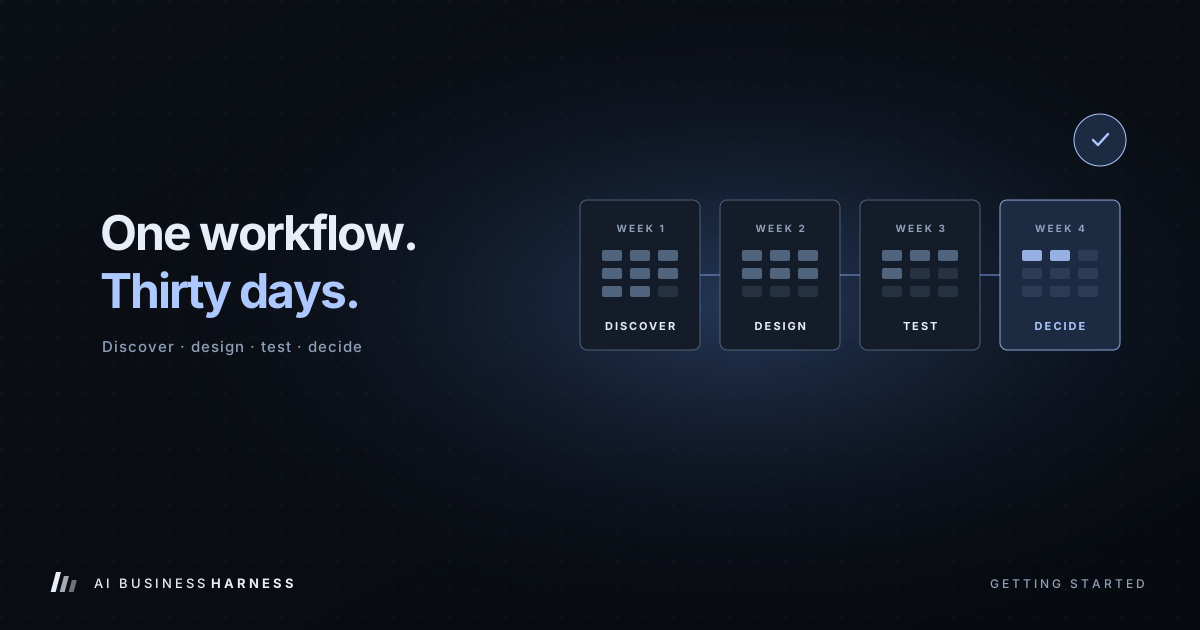
- 30-Day Installation. We build one or two workflows for your business, test them with your real tools and sample data, and hand them over ready to use. Installations start at $5,000.
- AI Operations Partner. We run your workflows month to month. That covers new workflows, monitoring, fixes and support as your business changes. It starts at $5,000 a month.
Every engagement starts with one question:
What's something your team does over and over?
If an answer comes to mind right away, that's your first workflow. Email jeremy@aibusinessharness.com with that answer, and we'll show you what it looks like with a harness around it.
Frequently asked questions
What is the Microsoft Copilot harness?
It's the system Microsoft uses to run AI agents across its Copilot products. It coordinates AI models, tools, skills and a safe workspace so agents can finish multi-step work. Microsoft announced it on October 28, 2026 and made it available to developers through Microsoft Foundry.
Can a small business use the Microsoft Copilot harness directly?
It's built for developers, so using it directly takes engineering work. Most small businesses are better served by a managed harness, where someone builds the workflows on top of an engine like Microsoft's and the owner only reviews and approves the work.
Is AI Business Harness a competitor to Microsoft?
No. Microsoft builds the engine that runs AI agents. AI Business Harness designs, builds and manages the business workflows that sit on top of an engine, and we can use Microsoft's or another one depending on the job.
Will my business be locked into Microsoft or one AI company?
Not with how we build. The Copilot harness supports open standards like MCP and agent skills, as do other major AI platforms. That means workflows can move between AI models and engines as the technology changes.
Sources: Microsoft: Introducing the Microsoft Copilot harness, GitHub: Copilot SDK