Property & real estate
How a Harness Pre-Checks a “Just Listed” Post Before It Publishes
An anonymized listing post, walked through a brokerage advertising pre-check, a publish gate, and the “Comment HOME” lead capture. The harness flags. The brokerage decides.
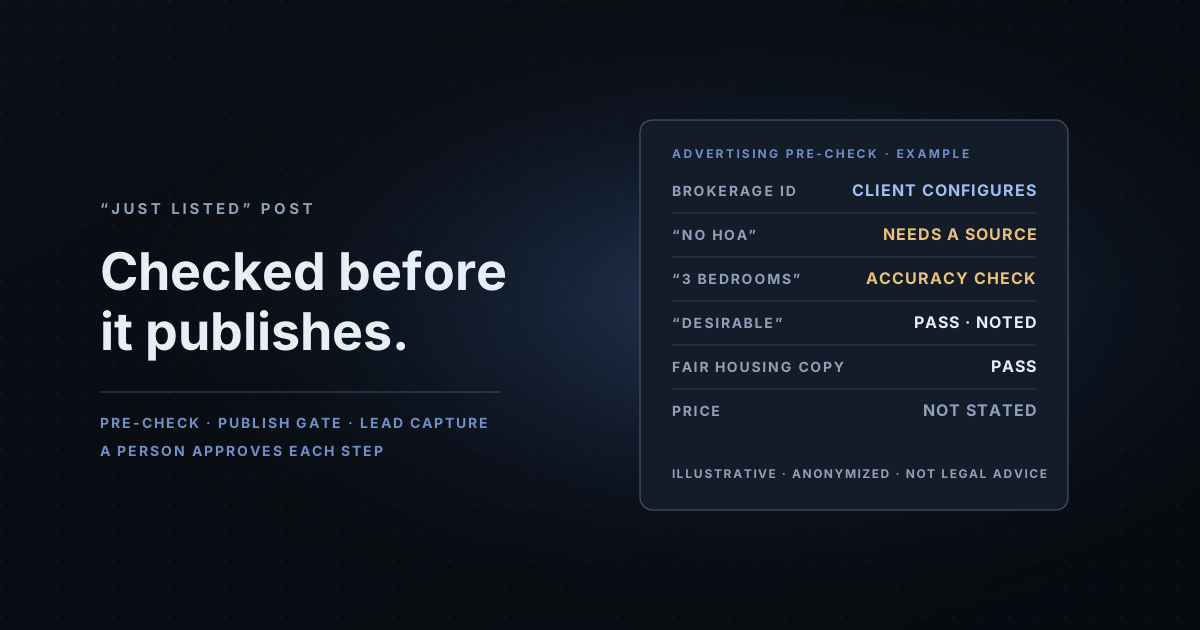
Illustrative example based on a real post, anonymized. Not legal advice.
Quick Answer
Before a “Just Listed” post goes out, a harness runs the brokerage's configured advertising checks, flags claims that need a source, and holds the post for a named person to approve. “Comment HOME” replies are drafted and held for approval too. The harness flags; the brokerage decides.
This is the second walkthrough in a short series. The first, from wholesale deal post to reviewed decision, followed an investor deal post through capture, the numbers and a comp check. This one follows the kind of post a brokerage publishes every week: a listing announcement on social media.
The two posts carry different risks. A deal post is about math. A listing post is advertising under a real estate license, so the checks are about who is identified, whether each claim is accurate, and who approved it.
What does a typical “Just Listed” post look like?
A typical one has an emoji hook, a short feature list, an address, a call to action such as “Comment HOME,” one or two agent contact lines, a team and brokerage line, and a block of hashtags. Every one of those parts is advertising, including the hashtags. Here is a post like this one, with identifying details removed.
👀 Looking for a home in [Area] with NO HOA? This one is worth checking out!
Located in a desirable neighborhood, this beautiful home offers 3 bedrooms, 2.5 bathrooms, a cozy outdoor fireplace, and a low-maintenance backyard perfect for relaxing or entertaining!
📍 [Street address], [City], AZ [ZIP]
💬 Could this be your next home? Comment HOME for more details or message us to schedule a private tour!
📲 [Agent One], REALTOR®
[Phone]
📲 [Agent Two], REALTOR®
[Phone]
Team Name | Brokerage Brand
Nothing about this post looks unusual. That is the point. Most listing posts are routine, and the useful job is to run the same checks on the routine ones, consistently, with a record.
What does an advertising pre-check look at in a listing post?
It looks at six things: whether the brokerage is identified the way the brokerage has configured, whether factual claims such as “NO HOA” have a source, whether the bedroom count is accurate, how neighborhood descriptors read, a fair housing copy review, and what is missing. Each result is recorded with the post.
| Check | Result | What happens next |
|---|---|---|
| Brokerage identification | Needs client configuration | The post shows a team name and a franchisor-style brand. The harness does not know whether that matches the brokerage's registered name. It asks the brokerage to configure that value, then compares every post, hashtags included, against it. |
| “NO HOA” | Needs a source | A factual claim, stated twice (headline and #NoHOA). It is held until someone attaches a source: the listing data, the title report or the brokerage's own record. If it is wrong, it is a misrepresentation. |
| “3 bedrooms” | Accuracy check | A bedroom count is a factual claim. If one of the three rooms is really a den or office, the count is wrong. A person confirms it against the listing record. |
| “Desirable neighborhood” | Pass, with a note | Common phrasing and generally fine. The record notes that a reviewer saw a neighborhood-quality descriptor, since that kind of wording sits closer to the fair housing line than “cozy outdoor fireplace.” |
| Fair housing copy review | Pass | No references to protected classes, no steering language, no exclusionary wording. The review describes the home, not who should live in it. |
| Price | Not stated | Informational only. Price isn't a required element of a social post. It is noted because it is the first thing many buyers will ask. |
Two rows need action before this post publishes: the brokerage name and the HOA claim. The bedroom count is a quick confirmation. The rest pass, and the record shows that they were checked rather than skipped.
How does the brokerage-identification check work?
The harness does not know the answer, and it does not guess. The brokerage confirms its registered legal name or d.b.a. once. From then on, the harness compares each post against that configured value and flags a missing or mismatched name for a person to resolve. The brokerage answers the question; the harness applies that answer to every post.
Arizona's advertising rule, A.A.C. R4-28-502, requires advertising to identify, in a clear and prominent manner, the employing broker's legal name or the d.b.a. name on the employing broker's license certificate. The Arizona Department of Real Estate's substantive policy statement on advertising makes the same point: the employing broker's legal or d.b.a. name appears in all advertising. Under A.A.C. R4-28-502(J), online advertising aimed at Arizona residents is advertising, and the required broker identification must appear on the ad itself, without the reader needing to scroll. A caption below an image may not satisfy that if the identification isn't visible without scrolling. The same subsection explicitly names artificial intelligence as a covered electronic medium.
In the example, the post shows “Team Name | Brokerage Brand.” Whether that brand line satisfies the rule depends on what the brokerage registered, which the post alone can't show. A franchise brand, a team name and the employing broker's licensed name can be three different things. The harness doesn't try to settle that by reading the post or searching the web. The sequence works like this:
- First run: a question, not a finding. With no configured value, the check returns “needs client configuration.” It does not say the post is wrong.
- The brokerage configures its name once. The designated broker, or someone they assign, enters the registered legal name or d.b.a. as it appears on the license certificate, and how it must appear in posts.
- Every post after that is compared against the configured value. If the name is present, the row passes. If it is missing or different, the post is flagged for a person to fix or approve with a reason.
The check covers the whole post, not only the caption. Hashtags are part of the ad, so the comparison runs on the hashtag block too. A team hashtag is not a substitute for the brokerage name, and a hashtag such as #NoHOA repeats a factual claim that still needs a source.
One pattern the check is built for is a post where the identification appears in the caption rather than in the image. The harness raises that placement as a question for the brokerage to review; it does not make a finding.
This is the most useful row in the table precisely because the harness can't answer it. It surfaces a question the brokerage has to answer once, then makes sure the answer is applied to every post after that.
Why does a “NO HOA” claim need a source?
Because it is a statement of fact a buyer may rely on. R4-28-502 requires advertising to contain accurate claims and not misrepresent facts. If the property turns out to have an HOA, the post was a misrepresentation. So the harness holds the claim until someone attaches a source: listing data, title, or the brokerage record.
The harness does not look the answer up and decide for itself. It requires that a source be attached, records which one, and keeps the flag open until it is. The same rule covers the bedroom count, the bath count and any other feature stated as a fact. It is the same class of issue as the tax-record square footage in the wholesale deal walkthrough: a number that looks routine until it turns out to be wrong.
What happens at the publish gate?
A named person approves this specific version of the post for this specific destination. The approval is recorded with who approved it and when. Approval to publish on Facebook does not cover reposting to Instagram or adding the post to the brokerage website. Each destination is a new action with its own approval.
The gate opens only after the open flags are resolved: the brokerage name matches the configured value, and the HOA claim has a source. If the copy changes after approval, even by one line, it goes back through the checks. That keeps the approved version and the published version the same thing.
Per-destination approval matters because posts change shape when they move. A caption that shows the brokerage name on Facebook can lose it in a cropped Instagram graphic, and a website listing card has its own layout. For more on scoped approvals, see human approval in AI workflows.
How should a “Comment HOME” lead be handled?
Treat each comment or message as an inbound lead. It is captured and saved first, classified, staged with the property and the source post, routed to an agent at an intake gate, and answered only after a person approves the exact reply. No automated DMs go to the prospective buyer.
“Comment HOME for more details” is an invitation to an automated reply, and that is exactly the step the harness keeps human. A message to a prospective buyer about a listing is a consumer communication under the brokerage's license. Here is the flow:
- Capture and persist. The comment or DM is saved before anything else happens, so a lead that arrives at 9 p.m. on a Sunday is not lost if a later step fails.
- Classify. Is it a buyer inquiry, a seller inquiry, a solicitation from another agent or vendor, or spam? A “HOME” comment and an “is this still available?” message are different intents and route differently.
- Stage. The inquiry is staged with the property reference, the source post and the channel it came from, so the agent sees which listing and which post produced it.
- Intake gate. A person routes the lead to a specific agent. On a two-agent team, that is a routing decision, not a bottleneck.
- Outbound gate. The reply, whether details, a tour offer or a scheduling link, is drafted and held. Nothing goes to the consumer until a person approves the exact text.
Speed still matters here. A held draft is only useful if someone approves it quickly, which is why the intake gate routes to a named agent rather than a shared inbox. Our guide to real estate lead response time covers how to measure that, and AI inquiry handling for brokerages covers what an assistant may and may not say.
What the harness does not do
The harness runs configured checks, holds work for approval, and keeps a record. It does not make the decisions that belong to the brokerage. Stating those limits plainly is part of the design, not a disclaimer added at the end.
- It doesn't decide the broker identifier. The brokerage configures its registered name once; the harness enforces that value.
- It doesn't certify compliance. It runs the configured checks and records the results. That is not a compliance certification, and it is not legal advice.
- It doesn't verify the HOA claim itself. It requires a source and flags the claim until one is attached.
- It doesn't send the DM. It drafts the reply; a person approves and sends it.
- It doesn't make the publish decision. The publish gate is a human approval, logged with the approver's name.
The managed AI operations assistant prepares the work. The harness controls what is allowed. Your team decides. See what to log when AI does business work for what that record should contain.
What does a harness add if the post was fine?
This post would probably publish as-is. The harness's contribution is that the next forty posts get the same checks, the flags get resolved before publication, and there's a record of who reviewed what.
That is a modest claim, and it is the one that holds up. A brokerage doesn't need software to write a listing post. It needs the broker-name check and the claim check to stop depending on whether someone remembered that day. For how this fits a team's wider workflow, see how a managed AI operations assistant works for real estate teams and our real estate brokerage front desk page.
If you want to start with the lead side, the no-cost Speed-to-Lead Check tests your team's actual inquiry paths and sends you the results.
Frequently asked questions
Does Arizona require the brokerage name on a social media listing post?
Arizona's advertising rule, A.A.C. R4-28-502, requires advertising to identify the employing broker's legal name or the d.b.a. name on the employing broker's license certificate in a clear and prominent manner. Under subsection J, online advertising aimed at Arizona residents is advertising, and the required identification must appear on the ad itself, without the reader needing to scroll. Confirm how that applies to your posts with your designated broker. This article is not legal advice.
Can a team name stand in for the brokerage name in an ad?
That depends on what the brokerage has registered, which is a fact about the brokerage, not something software can work out from the post. The rule refers to the employing broker's legal name or the d.b.a. name on its license certificate. The brokerage confirms its registered name once, and the harness checks each post against that configured value.
Can an AI assistant reply to “Comment HOME” comments automatically?
In this workflow, no. A comment or message is captured, classified and staged, but the reply to the prospective buyer is drafted and held until a named person approves the exact text. A message to a consumer about a listing is a brokerage communication, so it gets a human gate rather than an automated DM.
Is an advertising pre-check the same as a compliance certification?
No. A pre-check runs the checks the brokerage configured and records the result. It does not certify that a post complies with Arizona rules, fair housing law or MLS policy. The designated broker remains responsible for the brokerage's advertising, and counsel should review the checklist itself.
Does approving a post for Facebook also approve it for Instagram or the website?
No. Approval covers one version of the post for one destination. If the same post is reposted to Instagram or added to the brokerage website, that is a new action with its own approval, because the format, the visible text and the placement of the brokerage name can change.
Who is responsible for real estate advertising in Arizona?
Under R4-28-502, the designated broker is responsible for supervising the brokerage's advertising. A harness can make the checks consistent and keep a record of who reviewed what, but it does not take on that responsibility. The person who approves a post at the publish gate is accountable for that approval.
Sources
- Arizona Administrative Code, R4-28-502, Advertising by a Licensee (text via Cornell LII). Subsections C (accurate claims), E (employing broker's name), G (supervision by the designated broker) and J (electronic media, including artificial intelligence, and the requirement that advertising rules be satisfied on the advertisement itself without the need to scroll). Check the current official version with the Arizona Department of Real Estate.
- Arizona Department of Real Estate, Substantive Policy Statement on advertising and the employing broker's name.
- Fair Housing Act, 42 U.S.C. § 3604(c), on discriminatory statements in advertising; and HUD's Fair Housing Act overview.
Jeremy Mandile has worked in SEO and systems since 2006 and with AI tools since 2022. This article was prepared with AI assistance and reviewed before publication. It is an illustrative example based on a real post, anonymized. It does not describe a live deployment, it is not a compliance certification, and it is not legal advice.