Industry Guides
Real Estate Lead Response Time in 2026: What a 2,198-Inquiry Study Found, and a 7-Day Test for Your Own Team
A 2026 study tested 2,198 real estate inquiries. Here's what it found, and a 7-day test you can run on your own team.
Quick Answer
In Pied Piper's October 2026 study of 2,198 inquiries to 21 large real estate brands, only 33% of callers reached an agent on the call, and 68% of website inquiries got no response within 24 hours. The useful next step is to measure your own team's times.
A buyer calls the office, or fills in a form on a listing, and then waits. Industry articles have argued for years about how fast a real estate team should reply. A better move is to start with a dated study that actually tested offices, then measure your own team.
This guide covers the study's phone and website findings, why those gaps show up on real teams, a 7-day self-test you can run this week, and what improves response time without replacing agents. If you would rather not secret-shop your own office, book a no-cost Speed-to-Lead Check.
It is a different topic from our guide to AI inquiry handling for real estate brokerages, which focuses on Fair Housing, showing requests and listing facts. Use that article for what an assistant may say; use this one to measure how long people wait.
Book a no-cost Speed-to-Lead Check
What did the October 2026 study find about real estate lead response time?
Pied Piper's first residential real estate study, released October 5, 2026, submitted 2,198 phone and website inquiries to offices of 21 large brands. Only 33% of callers reached an agent on the call. Most inquiries then went quiet: 73% of phone inquiries had no 24-hour follow-up, and 68% of website inquiries got no response.
The firm, which has published customer-experience studies for more than 15 years, described this as its first look at residential real estate. Each inquiry followed a standardized customer scenario. Pied Piper tracked what happened for 24 hours across phone, text and email, then scored brands on a 0-to-100 Lead Handling Effectiveness scale. The figures below come from Pied Piper's October 5, 2026 press release. Florida Realtors later summarized the same numbers.
The study measured local offices of 21 large brands, not every independent team. Your results may be better or worse. That is why a self-test still matters, including for teams in Phoenix or the West Valley.
Phone inquiries
Most calls did connect. Connection was not the same as reaching an agent.
| What Pied Piper measured | Industry result |
|---|---|
| Calls that connected | 97% |
| Callers who quickly reached a representative (within 30 seconds) | 53% |
| Callers who successfully communicated with an agent during the initial call | 33% |
| Phone inquiries with no follow-up by phone, text or email within 24 hours | 73% |
| Average Lead Handling Effectiveness score for phone inquiries | 30 out of 100 |
When the first call did not reach an agent, responsibility was often left with the customer. A common outcome, the press release says, was for office staff to give the caller an agent's name and phone number. The customer might dial that number, or might move on to the next office.
Website inquiries
Website inquiries fared worse, from the form itself through the first day of follow-up.
| What Pied Piper measured | Industry result |
|---|---|
| Website inquiry forms that failed to work correctly | Nearly 1 in 10 |
| Website inquiries with no response of any type within 24 hours | 68% |
| Website inquiries that resulted in communication from an agent within 24 hours | 18% |
| Website inquiries contacted by an agent within one hour | 10% |
| Average Lead Handling Effectiveness score for website inquiries | 11 out of 100 |
Across phone and website inquiries combined, the industry averaged 21 out of 100 on Pied Piper's scale. Even the highest-ranked brand scored 30. The press release also reports that offices followed up within 24 hours 30% of the time, and used two or more follow-up methods (such as phone, text or email) only 9% of the time.
This post sticks to those industry averages. The study ranked individual brands; those rankings are not repeated here.
What about older “speed to lead” figures?
Older figures still circulate in roundups, including a widely cited 917-minute average often attributed to Inman. We could not verify that number against a current primary source, so it is not used as a benchmark here.
A separate, often-quoted finding does have a primary source, with an important limit. A 2007 Lead Response Management study presented by James Oldroyd, then a faculty fellow at MIT Sloan, and Dave Elkington of InsideSales.com, looked at web-generated leads at six companies. It was not a real estate study and it did not measure close rates. It found that the odds of qualifying a lead were 21 times higher when the first call happened within five minutes rather than 30 minutes. That is useful context for why minutes matter. It is not a conversion guarantee for a listing inquiry in 2026.
The practical conclusion is simpler than picking a favorite statistic: measure your own first-reply times, by channel, including nights and weekends.
Why do real estate teams miss or delay leads?
The gap is usually operational. Agents are in showings or at closings, office calls ring through to a cell phone, web forms land in a shared inbox nobody owns, and after-hours or Sunday inquiries wait until Monday. Some forms also fail quietly, so the team never sees the lead.
Those patterns match what the 2026 study observed: calls that connect but never reach an agent, follow-up that does not close the gap, and website forms that either fail or sit unanswered.
On a typical team, the weak points are often the same:
- The person who can help is already busy. Midday showings, inspections and closings take agents off the main line. A call that rings to a cell phone in a seller's living room is easy to miss or send to voicemail.
- Nobody owns the web inbox. Portal leads, website forms and ad forms can land in a shared mailbox, a personal email, or a CRM queue that several people assume someone else is watching.
- Nights and Sundays wait until Monday. Buyers often browse after work and on weekends. If the only plan is “an agent will get it in the morning,” a Sunday 8 p.m. inquiry can sit for 12 hours or more.
- The form looks fine and still fails. Pied Piper found that nearly 1 in 10 website inquiry forms did not work correctly. A broken form produces no lead for the team to return, which can look like “we didn't get any inquiries.”
- The first conversation stops at a callback number. Handing a caller an agent's cell number is not the same as connecting them. If nobody follows up by phone, text or email, the inquiry ends with the customer still doing the work.
None of that means agents are careless. It means lead intake is a process, and processes break when they depend on someone being free at the exact moment a stranger reaches out.
How do I test my team's speed to lead?
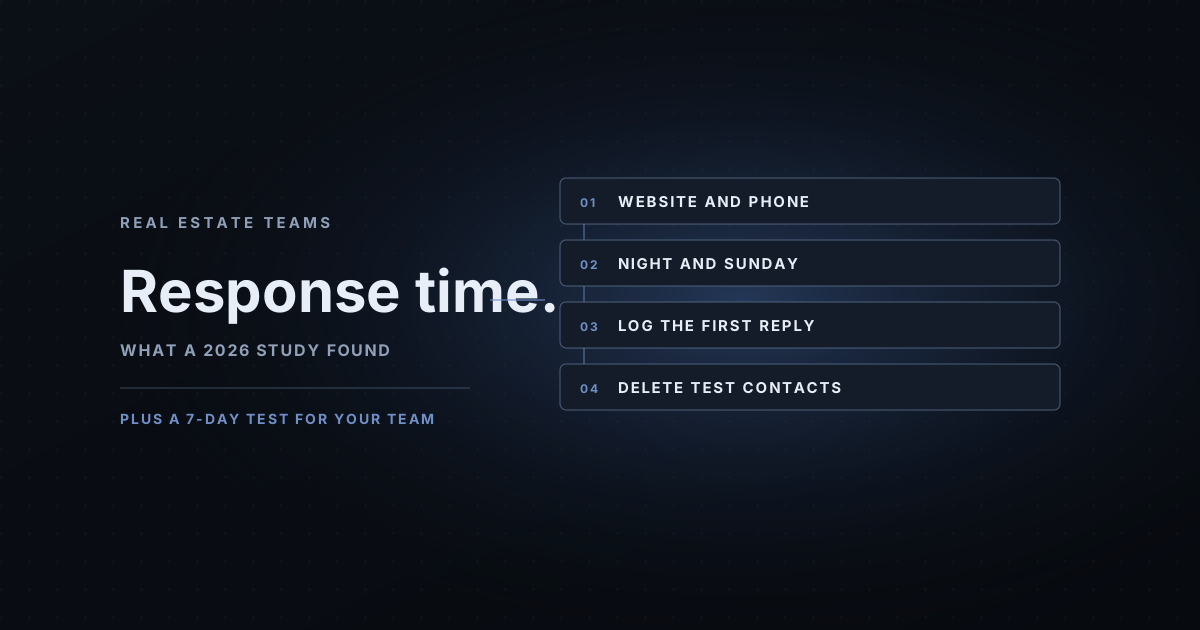
Run a 7-day self-test across five entry points: your website form, the main office line, one portal listing, a sign call, and a social ad form. Use numbers your team will not recognize. Send inquiries on a weekday afternoon, at 8 p.m., and on Sunday. Log first-reply time, the channel, and whether a person or an autoresponder answered.
You do not need a research firm to do this. You need a quiet week, a spreadsheet, and a couple of phone numbers and email addresses your team will not recognize as an internal test.
The five entry points
Test the paths a real buyer or seller would actually use:
- Your website form. A general “contact us” or “request a showing” form on your own site.
- The main office line. The number published on your site, Google Business Profile, or yard signs, not an agent's direct cell unless that is the public number.
- One portal listing. A live listing on a major portal, submitted as a buyer inquiry.
- A sign call. The number on a sign or ad, called as if you were driving by.
- A social ad form. If you run lead ads, submit one. If you do not, skip this row and note that in the log.
If a path does not apply to your team, skip it and write that down. Do not invent a result.
When to send the inquiries
Send at least one inquiry on each of these three windows, and try to cover every entry point at least once during the week:
- A weekday afternoon, when agents are most likely to be in showings
- About 8 p.m. on a weeknight
- Sunday
Stagger the tests so one burst of fake leads does not tip off the whole office. Use a first name, a callback number and an email address that are not already in your CRM.
What to log
For each inquiry, record:
- Date and time sent
- Entry point
- Whether the form or call path worked at all
- Time of the first reply
- Channel of that reply (phone, text, email, voicemail, in-app message)
- Whether a person, an autoresponder, or no one answered
- Whether a licensed agent actually connected, or the first contact was only a confirmation message
- Whether the inquiry appeared in your CRM
Then score the week with three simple buckets:
| First meaningful reply | How to count it |
|---|---|
| Within 5 minutes | Fast enough to catch someone still looking |
| Within 1 hour | Still timely, especially during business hours |
| None within 24 hours | The inquiry was effectively missed for a day |
A first meaningful reply is a response that moves the conversation: a person on the line, a personal text or email, or a clear next step. An automatic “we got your form” message is worth logging, but it should be counted separately from an agent connection. Pied Piper itself reported both “a response of any type” and “communication from an agent.” Your log should do the same.
Also check that each working form actually created a record in the CRM. A fast reply to an email that never hits the pipeline is still a process gap.
When the week is over, delete the test contacts so they do not skew lead counts or trigger more follow-up.
A team in Phoenix or the West Valley can finish this in one week and see whether the national pattern shows up on its own listings, ad forms and after-hours line. The point is not to catch an agent out. The point is to see which path breaks, and at what hour.
If you would rather have someone else run the test, that is what the no-cost Speed-to-Lead Check is for.
How can a team improve lead response time without replacing agents?
Keep agents on the work only they can do. Use an approved first reply on every channel, answer inbound calls when agents are in showings, record showing requests instead of promising tours, and route hot leads with a clear deadline. A person reviews what goes out. An AI assistant, if you use one, should handle inbound calls only.
Faster intake should not mean a bot that promises a Saturday showing, describes a neighborhood, or starts an automated outbound sequence. The job is to answer the person who just reached out, collect the basics, and hand the conversation to a licensed agent.
A practical setup usually includes:
- An approved first reply on every channel. The first text or email should use wording the broker has already signed off on. It can acknowledge the inquiry, ask a short set of qualifying questions, and offer to connect the person with an agent. It should not improvise listing advice.
- Inbound call coverage while agents are busy. When the main line would otherwise go to voicemail, an assistant can answer, take a message, and record a showing or valuation request. It should not confirm a tour, discuss agreement terms, or quote restricted listing details. Our real estate brokerage front desk page, and the worked Phoenix brokerage example, walk through that design. You can watch the short fictional after-hours buyer-call demo on this page if you want to hear a sample inbound call.
- Routing with a deadline, not a hope. Once a lead is qualified, it should go to the right agent by area, language or price range, with a clear time to take it. If that agent is in a closing, a backup should be defined in advance.
- Missed-call text back, with consent in mind. If a caller hangs up, a short text can offer a way to continue the conversation. Confirm consent and calling rules with counsel before you automate texts or callbacks. An AI assistant in this workflow handles inbound calls only and does not start automated outbound follow-up on its own.
- A weekly review of what was said. Someone on the team should listen to or read a sample of the week's first replies, including after-hours calls. That is how you catch a broken form, a script that drifted, or a handoff that never landed. Human approval in AI workflows is the control that keeps this from becoming a black box.
If your team already uses Follow Up Boss, keep the CRM as the system of record and be careful about what any connected assistant is allowed to write. Our Follow Up Boss integration guide explains the documented connection paths and why access should stay narrow.
For a broader way to think about unanswered calls, see how to calculate what missed calls cost and the AI receptionist ROI calculator. Use your own volume and close rates; do not plug in a national average and treat the result as a forecast.
If the 7-day test shows real gaps, a 30-Day Installation can set up the first-reply and inbound-call workflows, with human review on what goes out. There is also a voice demo if you want to hear how an inbound receptionist can sound before you change anything.
What is a Speed-to-Lead Check?
A Speed-to-Lead Check is a no-cost test we run on your team's actual inquiry paths, then send you the results. You do not have to secret-shop your own office. If you want to see what an after-hours inbound call can sound like, watch the short fictional buyer-call demo at the top of this page.
The check is a measurement, not a pitch deck. We test the same kinds of entry points described above and send back what happened: whether the path worked, how long the first reply took, and whether a person or an autoresponder answered. There is no obligation attached to the results.
Book a no-cost Speed-to-Lead Check ↗
Frequently asked questions
What is a good lead response time for real estate agents?
There is no single official standard. Many teams use a first-reply target measured in minutes, because a buyer or seller is often still looking when they submit the inquiry. In Pied Piper's October 2026 study, only 10% of website inquiries were contacted by an agent within one hour, and 68% received no response of any type within 24 hours. Use those checkpoints, plus a 5-minute bucket, to score your own team rather than treating any one number as a guarantee.
How do I test my team's speed to lead?
Secret-shop your own paths for seven days. Send test inquiries from unrecognized numbers to your website form, main office line, one portal listing, a sign call and, if you use them, a social ad form. Try a weekday afternoon, 8 p.m., and Sunday. Log first-reply time, the channel, whether a person or an autoresponder answered, and whether the lead landed in your CRM. Delete the test contacts when you are done.
Do auto-replies count as a response?
They count as a confirmation, not as an agent connection. An automatic “we received your inquiry” message can reassure someone that the form worked, but it does not replace a person following up. Pied Piper reported both “a response of any type” and “communication from an agent.” In your own test, log them as two different outcomes.
What is a Speed-to-Lead Check?
It is a no-cost test AI Business Harness runs on a team's inquiry paths, with the results sent back to the broker or team lead. The aim is to measure first-reply time and broken forms without asking you to secret-shop your own office. You can book a Speed-to-Lead Check when you want an outside pass. A short fictional after-hours buyer-call demo is available as well.
Why do website inquiries often get slower responses than phone calls?
In the 2026 study, website inquiries were the weaker path: nearly 1 in 10 forms failed, 68% got no response within 24 hours, and only 18% resulted in communication from an agent within 24 hours. Forms can land in an unwatched inbox, fail without anyone noticing, or arrive after hours with no owner. Phone calls at least reach a ring, even if only 33% of callers then spoke with an agent.
Can an AI assistant follow up with real estate leads automatically?
It should not run outbound follow-up on its own. If you use an AI assistant, keep it to inbound calls and approved first replies, with a person reviewing what goes out. It can record a showing request; it should not promise a tour, describe a neighborhood, or start automated outbound texts or calls. Have your managing broker and counsel review the setup. This article is not legal advice.
Does a fast first reply replace the agent?
No. A fast first reply is intake, not representation. A licensed agent still handles advice, agreements, negotiations and confirmed showings. The point of measuring response time is to get the inquiry to that agent before the person has moved on, not to let software take over the relationship.
Sources
- Pied Piper, “More Than Two-Thirds of Real Estate Inquiries Fail to Connect With an Agent”, press release, October 5, 2026.
- Amy Connolly, “Real estate inquiries often fail to reach agents,” Florida Realtors, October 13, 2026 (secondary summary of the same Pied Piper figures).
- James Oldroyd and Dave Elkington, Lead Response Management study, presented October 16, 2007, at MarketingSherpa's Business-to-Business Demand Generation Summit. B2B web-lead research, not a real estate study; did not measure close rates.
Jeremy Mandile has worked in SEO and systems since 2006 and with AI tools since 2022. This article was prepared with AI assistance and reviewed before publication. It is not legal advice.