Industry Guides
From Facebook Post to Reviewed Decision: How a Harness Handles a Wholesale Deal
Illustrative example using a real post. Not investment advice.
A wholesale deal post walked through five steps: capture, run the numbers, check the ARV, draft the next move, and approve. A person makes the call.
Quick Answer
A harness treats a wholesale deal post as an incoming lead. A managed AI operations assistant captures the numbers, runs the same arithmetic every time, checks the ARV against recent sales, and drafts a next step. A named person approves anything before it is sent, offered, or posted.
A post like this shows up in a feed:
Mesa, AZ 85212
Price: $544,000
ARV: $725,000
5 bed + den/office · 3 bath
4,313 SF (per tax records) · 8,750 SF lot
Pool · Built 2004
This is an example deal from a public investor post. The poster isn't named here, and the walkthrough below is illustrative.
The problem isn't reading the post. It's what happens next.
Anyone on an investor team can read those numbers. The trouble is what happens after. One person runs the math in their head, another forwards it with "looks good," a third replies to the wholesaler before anyone checks the ARV. Nobody can say later what was reviewed or why the team passed.
A harness doesn't make the deal better or worse. It makes the handling consistent: the same steps, in the same order, with a person deciding at the end. Here is how that works on this post.
Step 1: Capture
The managed AI operations assistant pulls the post into a deal record: price, ARV as posted, beds and baths, square footage and its source, lot size, pool, year built, the group it came from, and when it was seen. Anything the post doesn't say, such as the street address, repair scope, or assignment fee, is marked as missing rather than guessed.
Capturing the source of each number matters. "4,313 SF (per tax records)" is a different fact from "4,313 SF finished living area," and the record keeps that distinction.
Step 2: Run the numbers
Next, the assistant runs the same arithmetic on every deal post and shows its work, so the reviewer can check each line.
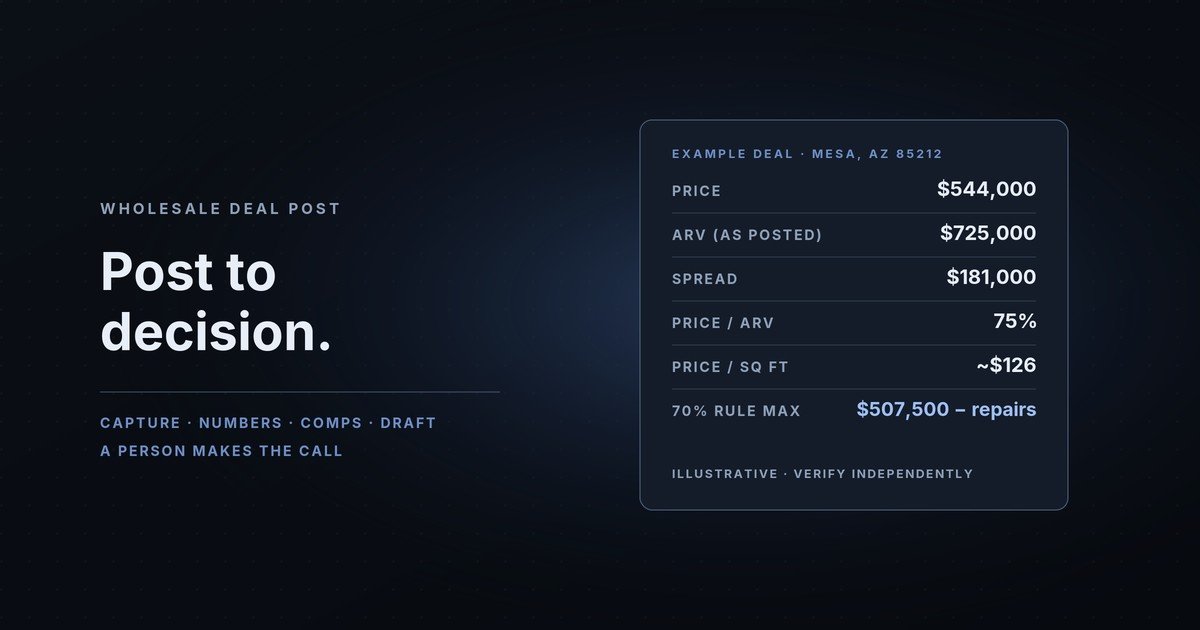
| Metric | Result | How it's calculated |
|---|---|---|
| Spread | $181,000 | $725,000 ARV − $544,000 price |
| Price as % of ARV | 75% | $544,000 ÷ $725,000 |
| Price per square foot | About $126 | $544,000 ÷ 4,313 SF (tax-record figure) |
| 70% rule maximum | $507,500 before repairs | 70% × $725,000, then subtract repair costs |
On paper the numbers work, but only narrowly. The asking price is already above the 70% rule maximum before a single repair is counted, so this only makes sense as a light-rehab deal. The assistant then flags what isn't verified yet:
- The ARV has no comps behind it. $725,000 is the poster's number until recent sales say otherwise.
- The square footage comes from tax records. Tax records sometimes count space that isn't finished living area. Every per-square-foot figure depends on it.
- Repairs are unknown. The 70% rule needs a repair number, and the post doesn't give one.
This is not underwriting. The harness runs arithmetic and surfaces what's unverified. Underwriting is a judgment call about risk, condition, market, and exit — and it stays with the person making the offer.
Step 3: Check the ARV against comps
The assistant then looks for recent sales near the property and links every one, so the reviewer can open the source. Here is what that check produced for this example.
- A similar-age home with a pool, not remodeled: 11259 E Spaulding Ave, Mesa, sold for $700,000 in June 2026 (Maricopa County Assessor record; Zillow listing, 4,558 SF, about $154 per square foot).
- A similar-age home, fully remodeled, smaller, no pool: 11346 E Spaulding Ave, Mesa, sold for $785,000 in November 2025 (Maricopa County Assessor record).
Those two recent sales in 85212 are consistent with the stated $725,000 ARV, which works out to about $168 per square foot on 4,313 SF, if two things hold: the 4,313 SF is real finished area, and the rehab reaches remodeled quality. Two sales bracket that number; they don't confirm it. A full comp set would be needed to confirm the ARV.
The size question could still sink it. 4,313 SF is unusually large for this ZIP code. If the finished area turns out closer to 3,500–3,800 SF, the same ARV needs a much higher price per square foot, and the margin gets tight. That goes to the top of the questions for the wholesaler.
If comps can't be found or don't support the number, the harness says that. It doesn't round up to make the deal work.
Step 4: Draft the next move
With the numbers and the comp check in the record, the assistant prepares one of three drafts for the reviewer:
- Questions for the wholesaler: the street address, the repair scope, access for a walkthrough, the assignment fee, and whether the 4,313 SF is all finished living space.
- A deal sheet for your buyers list: the numbers, the open questions, and the comp links, written so nothing is overstated.
- A pass note: a short, polite reply that says why the deal doesn't fit right now.
Nothing is sent until a person approves the exact text.
Step 5: Approve
A named person approves each specific action: this reply, to this wholesaler, with this wording. Approvals don't carry forward. Approving one message doesn't approve the next one, and approving one deal doesn't approve the next deal. Every deal and decision is logged, so the team can see what was reviewed, what was flagged, and why it moved forward or didn't.
That's the same approve-first pattern described in human approval in AI workflows and in our guide to how a managed AI operations assistant works for real estate teams.
What this is not
- Not investment advice. The numbers above are an example. Verify every figure independently before you make an offer.
- Not a compliance certification. A wholesale deal post is not a brokerage listing, and different considerations apply. Check your own obligations with your broker or counsel.
- Not an automated sender. The assistant drafts. It doesn't reply, offer, or post on its own.
- Not a substitute for judgment. The model suggests, the harness controls, and you decide.
The short version
Every deal post gets read consistently, the arithmetic gets run the same way every time, the ARV gets checked instead of assumed, and a person makes the call — with a record of what was reviewed.
If your team handles deal posts, inbound calls, or web leads differently depending on who sees them first, start with a no-cost Speed-to-Lead Check. If you'd rather talk through your own workflow, book a Fit Call.
The inconsistency is the thing worth fixing first.
Frequently asked questions
How does a harness handle a wholesale deal post from Facebook?
It treats the post as an incoming lead. A managed AI operations assistant captures the numbers into a deal record, runs the same arithmetic every time, checks the stated ARV against recent sales, and drafts a next step. Nothing is sent, offered, or posted until a named person approves the exact text.
Is running the 70% rule the same as underwriting the deal?
No. The harness runs arithmetic and surfaces what is unverified, such as an ARV with no comps or square footage taken from tax records. Underwriting is a judgment call about risk, condition, market, and exit, and it stays with the person making the offer.
What happens if comps don't support the posted ARV?
The harness says so. If comps can't be found or don't support the number, the deal record shows that plainly, with links to what was checked. It doesn't round up to make the deal work, and the person reviewing the deal decides whether to ask questions, pass, or keep looking.
Does the assistant reply to the wholesaler or make offers on its own?
No. It drafts questions for the wholesaler, a deal sheet, or a pass note. A named person approves each specific action, and approvals don't carry forward to the next message or the next deal. Every deal and decision is logged so the team can see what was reviewed.
Disclaimer
Illustrative example using a real post. Not investment, legal, or tax advice. The deal figures come from a public investor post and the comp figures from the linked public records; verify everything independently before acting.
Jeremy Mandile has worked in SEO and systems since 2006 and with AI tools since 2022. This article was prepared with AI assistance and reviewed before publication.