AI Front Desk
How to Evaluate a Business Operations Harness
A practical buyer’s checklist for permissions, approval stages, records, stop conditions, independent checks, measurements, and data ownership.
Quick Answer
Evaluate a business operations harness by checking what it can do, what requires approval, and what happens when work goes wrong. Ask for code-enforced permissions, saved proposals and decisions, stop conditions, opt-out blocks, independent checks, measurable outcomes, and written data-exit terms. Separate demonstrated controls from installation plans.
A convincing intake demonstration is not enough to choose an operating partner. For a contractor, law office, or appointment-based business, the useful question is whether a workflow can stay inside its agreed job when information is missing, a customer changes their mind, or the owner is unavailable.
This checklist is a buying guide, not a ranking. Use it to inspect one narrowly scoped workflow before expanding. It complements our human-in-the-loop intake guide and explanation of prompts and harness controls.
Book a Fit Call to scope one workflow ↗
What should the agent be allowed to do?
Start with a written permission list and a demonstration of a rejected action. Instructions alone are not an access boundary. Ask which code checks a proposal, which credentials are available, and whether the agent can change its own rules. Inspect the permitted actions rather than accepting a reassuring answer.
For example, if an intake agent must not send prices, its permissions should not allow price sending. Test a direct request for a quote and an indirect request hidden inside a customer note. A polite refusal is useful, but the stronger evidence is a denied action outside the permitted tool set.
ABH's current local harness checks proposals against a separate policy and an agent tool allowlist. Unknown tools are denied. It is proposal-only: it does not execute customer actions. That demonstrates a code boundary around proposals, not a connected production sender or a comprehensive price-content filter.
Who approves each message, and when can that change?
Define approval stages before connecting a customer-facing channel. Stage 1 should require the owner to approve every message before it leaves. Any later delegation needs a narrower written scope, evidence from review, and a separate authorization. Time passing should not silently grant the agent more permissions or new actions.
ABH's documented Stage 1 operating model requires owner approval of every customer-facing message. Stage 2 requires 30 clean days, testing, and a separate yes. Define “clean” during scoping, including how blocked attempts, unresolved exceptions, and owner corrections affect readiness. Stage 2 is not enabled in today's prototype.
Ask to see how a rejection, an edited draft, and an expired approval are handled. A status saying “pending approval” is not evidence that an owner approved something. ABH's current harness produces proposals and policy decisions; a connected approval-and-send queue remains installation work.
What records should you be able to inspect?
Require saved records of every proposal and decision within the agreed workflow. The record should let a reviewer connect the input, proposed action, policy result, human decision, and eventual outcome where applicable. Agree access, retention, and correction rules before launch, and inspect a sample export rather than just a dashboard.
ABH's local evidence contains proposals, reasons, and policy outcomes. These are not completed client-approval or delivery records. For a connected installation, require an explicit link from the reviewed draft to the authorized action. Ask how a later edit invalidates approval and how sensitive content is limited in records.
When should work stop or go to a human?
Write three exits: the task is done, its budget is exhausted, or progress has stalled. Each needs an observable condition and a named owner. A completed task can close; budget exhaustion and stalls should stop automated work and create a human handoff with enough context to decide what happens next.
| Exit | Evidence to request |
|---|---|
| Done | A defined completion check and an example of a closed task. |
| Budget | Attempt, time, and spend limits, plus a stopped-task handoff. |
| Stall | A missing-data or tool-failure example routed to a named person. |
The ABH workflow specification describes these exits. Treat that document as a design standard, not evidence that every timeout or budget check is automated today. Test unavailable tools, contradictory facts, and repeated failures before enabling a connected workflow.
Does an opt-out actually block contact?
An opt-out should be an enforced stop condition, not merely another note in the conversation. Ask for a test showing that opted-out contacts cannot receive a proposed send through the workflow. Also check queued drafts, delayed jobs, and the point immediately before dispatch in any connected implementation.
ABH's local policy blocks message drafts and send proposals when the supplied context or arguments mark a contact as opted out. A human approval request does not override that explicit policy block. This is narrower than proving consent synchronization across installed systems; that connection and last-moment check require installation-specific testing.
Who checks changes before they reach customers?
Ask for acceptance checks and a reviewer separate from the person or agent making the change. The reviewer needs the requirements, test evidence, risks, and rollback plan. A change should not be called ready merely because its author says it works or because one demonstration ended without an error.
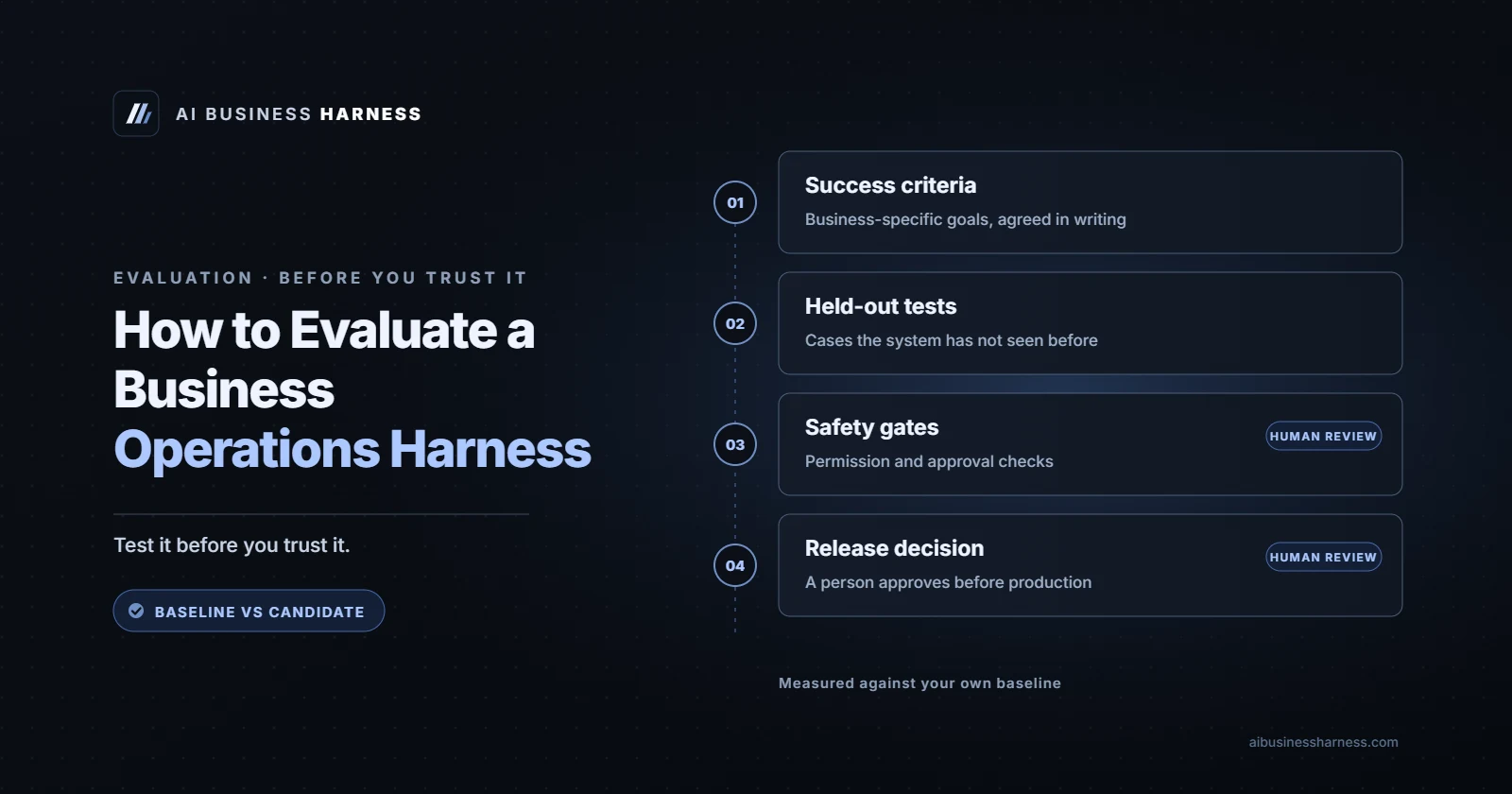
ABH documents five gates: specification, permissions, automated verification, independent review, and release approval. They are an engineering standard, not five universally automated services. Ask which checks are implemented for your workflow, which are manual, and which still need building. A manual gate should have a named reviewer and recorded decision.
How should weekly improvement work?
Use a weekly review to turn failures into specific proposed rules or tests. Review blocked attempts, missing drafts, wrong handoffs, owner edits, and incomplete work—not just successful runs. Assign each finding an owner and a check that could demonstrate the proposed fix, then review the change before adding it.
ABH's documented rule is that every failure becomes a finding and a proposed rule or test. Local evaluation findings include root causes and regression proposals. That is evidence of the improvement method, not proof that every proposed fix has shipped or that a weekly client-review service is already connected.
Which before-and-after measurements matter?
Agree a baseline before installation and compare the same definitions afterward. Useful measures include time spent reviewing, unanswered inquiries, review turnaround, owner corrections, completed follow-ups, and booked appointments where attribution is available. Keep failed and stopped work visible, and separate the workflow's activity from customer outcomes it cannot control.
Write down the observation window, source records, duplicate handling, and who checks the numbers. Include setup effort, ongoing review time, and operating costs. A reduction in drafting time does not by itself establish more revenue. ABH's synthetic demonstrations are not before-and-after client results.
Who owns the data, and what happens when you leave?
Get written terms covering business records, customer data, workflow configuration, and access credentials. Ask what can be exported, in which format, at what cost, and by when. Define revocation, deletion, retention exceptions, and responsibility for scheduled work after cancellation. Do not assume account access is the same as ownership.
This is a procurement requirement, not a claim that ABH already provides an automated export or deletion system. Request the actual agreement and a sample handover. Confirm who disables pending work, removes access, and checks that the business can continue without the managed workflow.
What questions should you ask any vendor?
Ask for a small evidence packet rather than a long feature list. It should show one rejected action, one approval path, one opt-out, one stop condition, and one reviewed change. Label each item as demonstrated, manually operated, or planned so a prototype is not confused with an installed service.
- Which actions are denied in code, and can you demonstrate a denial?
- Who approves each message, and what separately authorizes Stage 2?
- Can I inspect saved proposals, decisions, and unresolved failures?
- What stops the workflow on opt-out, exhausted budget, or a stall?
- Who independently reviews changes, and what did the last failure teach you?
- Which before-and-after measures will we use, and what can I take when I leave?
For workflow context, see Estimate Follow-Up, intake for law firms, and intake for plumbers and contractors. A Founding Client conversation should begin with scope and evidence, not assumed integrations. Book a Fit Call to identify one workflow and its acceptance checks.
Frequently asked questions
What is a business operations harness?
It is the control layer around an agent's work: permissions, review stages, records, checks, and stop conditions. Evaluate the controls for a specific business workflow rather than assuming a broad feature list proves readiness.
Does ABH's current harness send customer messages?
No. The current local harness is proposal-only and produces proposals and policy decisions. A connected approval-and-send queue is installation work, not an enabled capability of that prototype.
Does Stage 2 begin automatically after 30 days?
No. ABH's documented progression requires 30 clean days, testing, and separate authorization. Stage 2 is not enabled in the current prototype; its permitted scope must be agreed separately.
Are all five gates automated today?
No. The five gates are a documented engineering standard. Buyers should ask which checks are automated, which require a person, and which still need implementation for their workflow.
What should a weekly review produce?
It should produce findings, proposed rules or regression tests, named owners, and evidence needed to accept a fix. A proposed improvement should not be described as a completed change before review and verification.
What should I confirm before leaving a service?
Confirm export formats, ownership terms, access revocation, pending-work shutdown, deletion timing, and retention exceptions in writing. These are questions to settle in the agreement, not capabilities to infer from a demonstration.
Draft prepared for Jeremy Mandile's review. Operational descriptions are limited to ABH's local harness evidence and documented standards; no installed-client outcomes are claimed.