Phoenix metro · Plumbing workflow planning
AI Receptionist for Plumbers in Glendale, AZ
An owner-approved plumbing intake plan for Glendale: service-area checks, local handoffs and clear limits. ABH installation from $5,000 one-time.
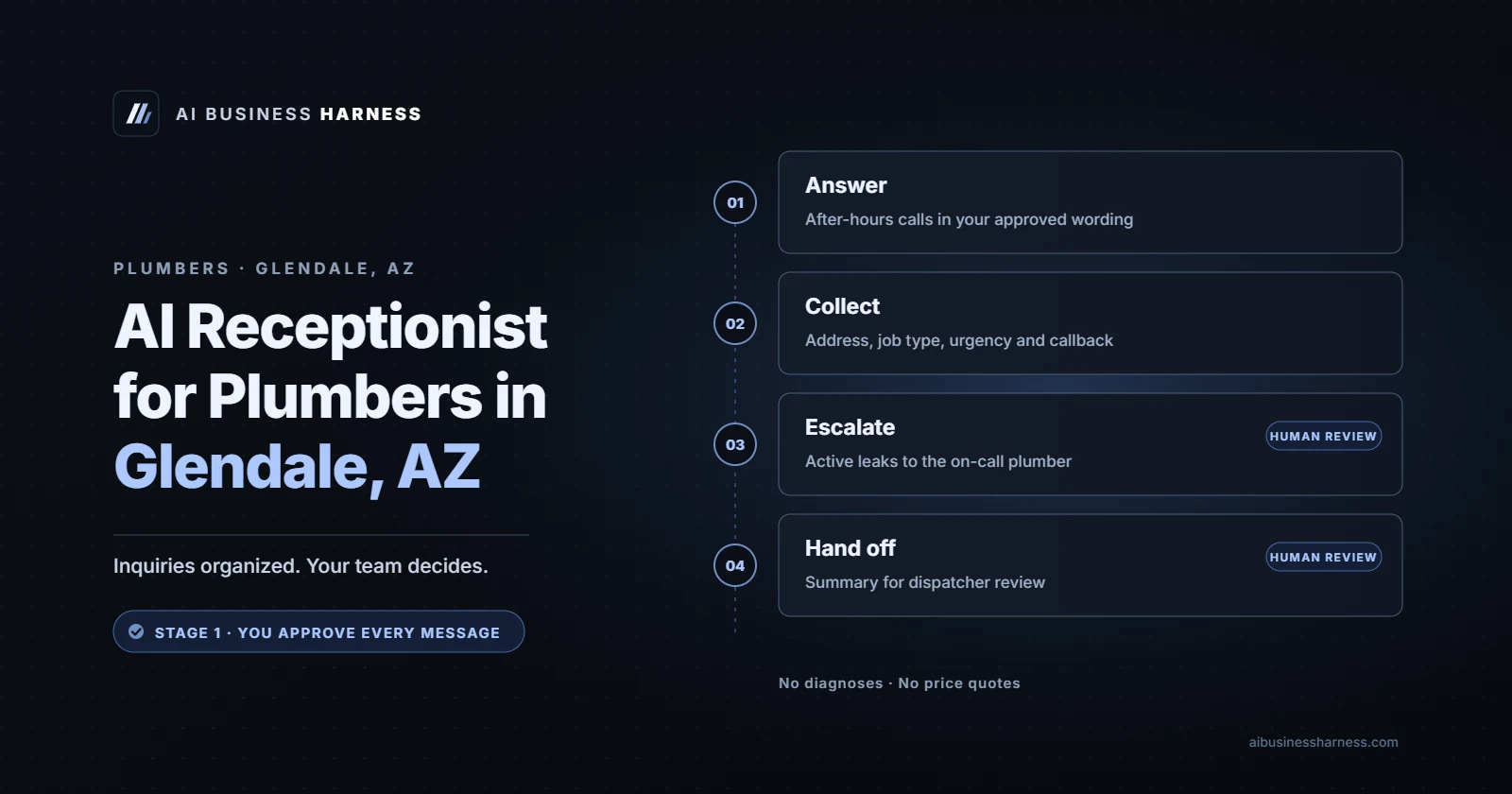
AI receptionist planning for Glendale plumbers: Start with accurate service-area intake and an owner-reviewed handoff, not autonomous dispatch. ABH’s 30-Day Installation starts from $5,000 one-time; software and usage are separate.
Glendale plumbing inquiries can combine older central-city properties, Arrowhead-area homes and businesses around the sports and entertainment district. Good intake distinguishes a single-home repair from a commercial or managed-property issue before the office starts making commitments.
Capture property responsibility before proposing a visit
A caller near Historic Downtown Glendale may be a tenant, a business operator or the owner. Around Westgate, a location name may refer to a suite inside a larger managed property. Ask who can authorize the work and who controls access. Arrowhead-area appointments may need a gate or community entry instruction, but security information belongs only in the company’s approved system.
ZIPs to review with your office: 85301, 85302, 85304, 85305, 85306, 85307, 85308 and 85310. This is a planning list, not a postal-boundary certification or a promise that every property is covered. Your written service map controls.
Summer, monsoon and coverage planning
If your team serves the Westgate area, event-day access can be a dispatch consideration; the office should verify conditions rather than have AI infer them. In summer and monsoon weather, keep a plumbing service request separate from storm access issues or a shared-building report. A weather event does not prove the cause of a leak.
The National Weather Service Phoenix explanation of the typical monsoon pattern provides the weather context. Weather is a reason to test staffing and handoffs, not evidence that AI will produce more jobs.
A local intake scenario to rehearse
Hypothetical example, not a client call: A retail tenant near Westgate reports water at the rear of the unit. A useful review note distinguishes the tenant contact, building manager and affected location, and flags uncertainty about who authorizes common-area work. The owner chooses the next step; no automatic alert goes to the landlord.
Stage 1: your approval is the action boundary
We start with a proposal-only workflow: sample inquiries become structured intake notes, suggested routing and draft follow-ups in a review queue. The owner or an authorized team reviewer approves; nothing sends on its own in Stage 1. No automatic booking, text-back, live call transfer, price quote or dispatch. Your staff handle urgent calls through your existing phone process.
An AI phone service that answers real callers is a separate capability, not something this Stage 1 workflow silently turns on. Any later live answering or integrations require their own written scope, permissions, consent review and scenario testing. Hearing the fictional plumbing voice demo is not proof that your business is connected or ready to take calls.
Glendale intake worksheet: caller, approver and building contact
Use separate fields for the caller, the person authorized to order work and the building contact. At a multi-tenant property near the entertainment district, those may be three different people. A plumber should not arrive expecting the tenant to authorize a common-line repair when building management has not reviewed the request. The workflow can identify that gap before the office makes a commitment.
For a central Glendale rental, rehearse a tenant reporting the issue while the property owner is unavailable. For an Arrowhead-area appointment, rehearse a homeowner who can approve the work but has not arranged access. For a Westgate-area business, rehearse a location description without a suite number. Each output should name the unresolved field and the next reviewer, not simply label the inquiry “urgent.”
Acceptance tests before connecting any customer system
- A caller says the building manager approved repairs, but no authorization is documented: flag the gap.
- A request near an event venue includes a blocked entrance: record it for dispatch review without claiming a traffic delay.
- An Arrowhead resident gives a gate code: exclude it from broad notification text.
Run those cases on sample data. Check missing fields, approval ownership, refusal to invent a price or ETA, duplicate inquiries and the fallback when a tool is unavailable. A STOP request should end proposed outreach. If the reviewer is unavailable, the proposal stays pending; it does not become permission to send.
What could a missed call cost? Use your own numbers.
Illustrative calculation, not a local statistic or a promised result: 12 unanswered qualified calls × 25% that might become completed jobs × $400 average collected job revenue = $1,200 in potential revenue. At a hypothetical 40% contribution margin, that is $480 before software, usage, staff review and installation costs. None of these inputs is an ABH client result or a claim about this city.
Use your phone logs to separate spam, repeat calls, out-of-area work and customers who called back. Count only additional completed work you can actually service. Compare incremental contribution profit, not headline revenue, with the full cost. Try the missed-call calculator, then reconcile it with your own records.
ABH pricing: installation is not a phone subscription
The 30-Day Installation is from $5,000 one-time for up to two defined workflows. The Founding Client Program lists $3,500 one-time through January 31, 2027, or until three places are filled; confirm availability and the published terms.
Optional AI Operations Partner management is from $5,000 per month on a 90-day starting term. Third-party software and usage are separate. Scope, feasibility, approvals and price are agreed in writing before work begins. Read the cost comparison and hidden-cost checklist.
Next steps for your plumbing office
For a defined follow-up workflow beyond intake, explore owner-approved Estimate Follow-Up. It is a separate scoped offer, not an automatic add-on to these installation prices.
Read the plumbers and contractors workflow overview for the broader service, then bring two anonymized intake examples and your current service map to a Fit Call. We measure what happens today before recommending an installation.
Back to the Phoenix metro planning hub · Statewide Arizona service
Frequently asked questions
Does ABH have a separate office in Glendale?
No separate city office is claimed here. ABH lists its Arizona address in Glendale and delivers this workflow work remotely, using only the access agreed in writing.
Can the Stage 1 workflow dispatch a plumber in Glendale?
No. Stage 1 prepares intake notes, routing suggestions and drafts for an owner or authorized reviewer. It does not dispatch, book, transfer calls or send customer messages on its own.
Is the installation price different for this area?
ABH publishes the same 30-Day Installation starting price: from $5,000 one-time for up to two defined workflows. Software and usage are separate. Final scope and price are agreed in writing; the Founding Client offer has separate terms and availability.