AI Business Harness · For real estate brokerages and teams
Broker Harness: One AI System Behind Every Agent in Your Brokerage
Fast first replies to new leads. One follow-up playbook for the whole team. The broker sees everything.
Broker Harness is a managed AI lead follow-up and operations system for real estate brokerages and teams. It connects to the lead sources, CRM, calendars and transaction software you already use, follows a playbook the broker approves, and hands anything sensitive to a licensed person. Installed in 30 days. Serving brokerages across Arizona and Oregon, including Phoenix, Scottsdale and Paradise Valley.
Short answer: Broker Harness is not a chatbot. It is a managed AI system that:
- replies to new leads within about a minute, day or night, from any source (a design target, not a promise);
- asks the qualifying questions and routes the lead to the right agent by area, price range and language;
- keeps long-term buyers and past clients warm for months, and tracks every contract deadline to close;
- gives the broker one weekly report on response times, appointments, files at risk and what the system changed.
Agents keep the relationship, the advice and the negotiation. The broker approves the rules. Nothing about price, offers or contracts goes out without a licensed person.

Quick check for brokers: submit a test inquiry on one of your own listings at 8 PM tonight. Time how long it takes for a human to reply. That number is your starting point, and it is the first thing we measure.
Who Broker Harness is for
Independent brokerages and franchise offices with roughly 10 to 200 agents, and teams inside them, where the broker or team lead can see the same three problems every week:
- Leads that arrive at night and on weekends wait until someone sees them. A 2013 WAV Group study found that 48% of buyer inquiries to brokerages were never answered at all.
- Some agents respond fast and follow up for months. Others don’t. The broker can’t see who is slow until a deal is lost.
- Each agent runs their own follow-up, so the brokerage has 60 playbooks instead of one, and the broker has no clean way to improve any of them.
If you run a team under 10 agents, the same system works at a smaller scope; we quote it on the Fit Call.
What Broker Harness does: six workflows
Every installation starts with the workflow that costs you the most right now, usually speed to lead, and adds the rest as the broker is ready. Each one runs on the same harness, so the second workflow is faster to add than the first.
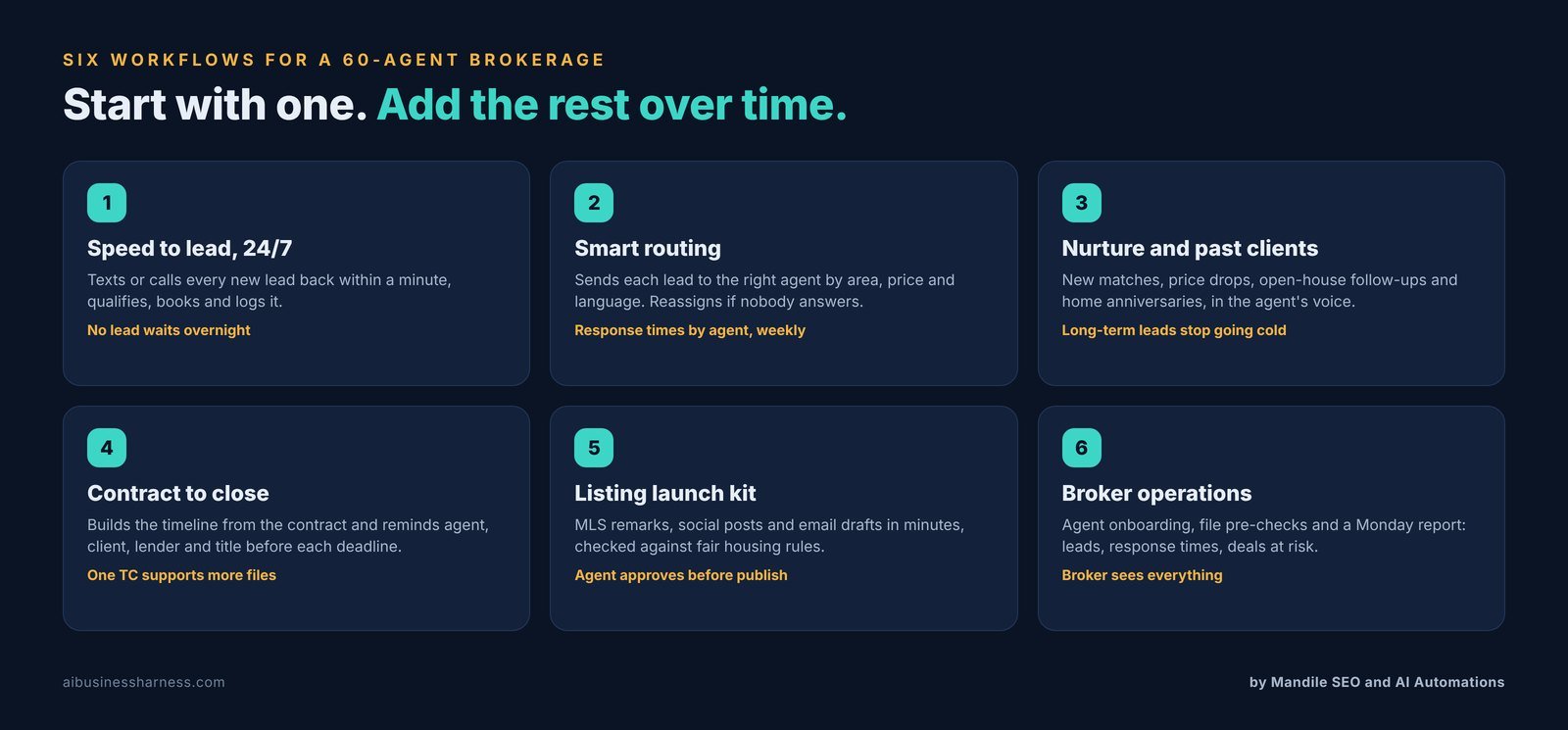
1. Speed to lead, 24/7
- Trigger
- A new lead from any source, at any hour.
- What the AI does
- Texts or calls back within about a minute (the design target), introduces the brokerage, asks the qualifying questions (timeline, price range, pre-approval, home to sell, preferred areas), offers showing or consult times and logs it all in the CRM.
- Where a person steps in
- The agent confirms the appointment and takes over the conversation.
- Result
- Night and weekend leads get a reply instead of waiting until morning, and agents start the day with warm, qualified appointments.
2. Routing by area, price range and language
- Trigger
- A lead is qualified.
- What the AI does
- Matches the lead to the agent whose territory, price range and language fit, using the rules the broker wrote. Hands off with the full conversation so nobody asks the same questions twice. Spanish-speaking leads get a Spanish-speaking agent when the brokerage has one.
- Where a person steps in
- The broker sets and changes the routing rules. The agent accepts or bounces the lead.
- Result
- Fewer leads sitting with the wrong agent, and a routing log the broker can audit.
3. Long-term nurture
- Trigger
- A lead says “not for six months,” or goes quiet.
- What the AI does
- Sends useful check-ins on a schedule the broker approves: new listings that match, a rate or market note the brokerage wrote, a reminder before a lease ends. Notices when someone re-engages and alerts the agent.
- Where a person steps in
- The agent picks up the moment the lead is ready to talk.
- Result
- Buyers who would have been forgotten come back to the agent who first helped them.
4. Past clients and referrals
- Trigger
- Closing anniversaries, home value updates, a referral request window.
- What the AI does
- Drafts the personal note for the agent to approve or sends the brokerage-approved version, tracks replies and flags anyone who mentions moving.
- Where a person steps in
- The agent makes the call when a past client raises their hand.
- Result
- Repeat and referral business that depends on a system instead of on each agent’s memory.
5. Contract to close
- Trigger
- A file opens in your transaction software.
- What the AI does
- Builds the deadline calendar from the contract dates, reminds the right people before each one (inspection period, appraisal, loan contingency, close), chases missing documents and flags a file that is falling behind.
- Where a person steps in
- The transaction coordinator and agent handle every contract question and every negotiation. The AI never advises on terms.
- Result
- Fewer missed deadlines and a coordinator who spends time on the files that need it.
6. The broker’s weekly report
- Trigger
- Every Monday morning.
- What the AI does
- One page: median first-reply time by source, appointments set, leads that stalled and why, files at risk, and the one change the system proposes for next week.
- Where a person steps in
- The broker reads it in five minutes and approves or declines the proposed change.
- Result
- The broker runs the brokerage from numbers instead of from whoever complained last.
Chatbot, human ISA, or Broker Harness?
Most brokerages already have a point tool somewhere: an AI texting add-on in the CRM, a chat widget on the website, or an inside sales agent (ISA) working leads by hand. Each solves one piece. Here is how they compare on the things brokers ask about.
| What brokers ask | AI texting tool or chat widget | Human ISA | Broker Harness |
|---|---|---|---|
| Channels | Usually one: text or web chat | Phone and text, during their shift | Text, email, phone and your CRM, around the clock |
| Scripts | Vendor’s templates, lightly edited | Whatever the ISA was trained on | Your playbook, in your voice, approved by the broker |
| After the first reply | Stops, or hands to the agent with little context | Depends on the person and the day | Routes with the full conversation, nurtures for months, tracks the file to close |
| Compliance | Settings you configure yourself | Training and supervision | Written rules, approval gates for anything sensitive, STOP handling, a log of every message |
| Gets better over time | When the vendor ships an update | With coaching | Every week: one proposed change, tested in shadow, approved by the broker or rolled back |
| Who owns the playbook | The vendor | The ISA, until they leave | Your brokerage, documented |
| Cost shape | Monthly software fee | Salary or hourly plus a bonus per appointment | One installation fee; optional monthly partner plan |
Broker Harness is not against point tools or ISAs. Many brokerages keep both. The harness is the layer that connects them, gives them one playbook and lets the broker see the whole picture.
How it is installed: 30 days, with shadow mode first
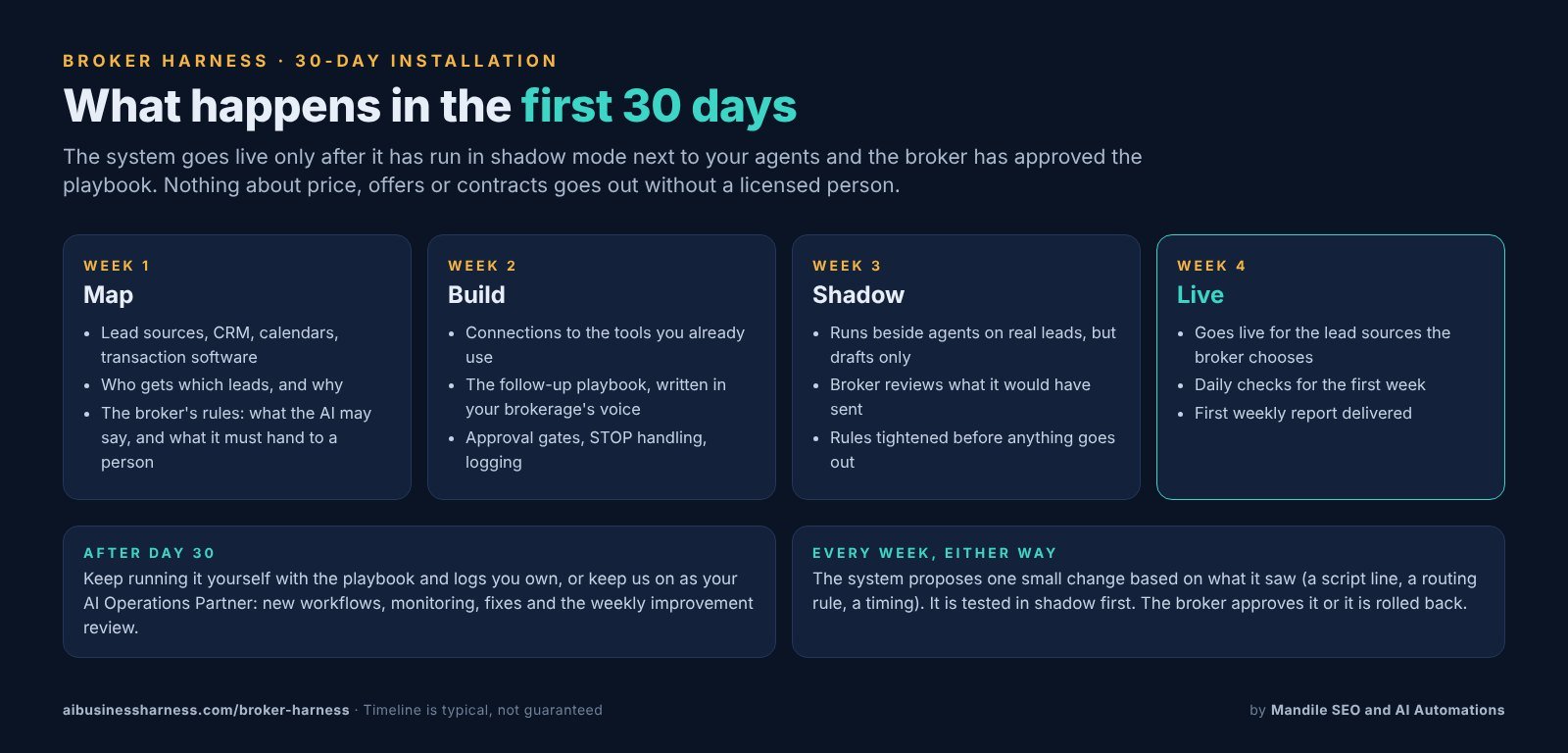
- Week 1, Map. We sit with the broker and operations manager and write down where leads come from, where they are supposed to land, who gets which leads and why, and the rules: what the AI may say, and what it must hand to a person.
- Week 2, Build. We connect the harness to the tools you already use, write the follow-up playbook in your brokerage’s voice, and put the guardrails in: approval gates, STOP handling, duplicate protection, logging.
- Week 3, Shadow. The system runs beside your agents on real leads but only drafts. The broker reviews what it would have sent. Rules are tightened before anything goes out.
- Week 4, Live. It goes live for the lead sources the broker chooses. We check it daily for the first week and deliver the first weekly report.
Guardrails: what stays with people
The harness is the part of the system that keeps the AI inside the lines. For a brokerage, the lines are written down before launch:
- Licensed-person rules. Pricing, offers, negotiation, contract questions, and anything about a specific property’s condition go to an agent or the broker. The AI schedules, reminds and asks qualifying questions; it does not advise.
- Fair housing. The AI does not characterize neighborhoods, schools or who lives where. It asks every lead the same qualifying questions. The playbook is reviewed by your broker and your own counsel.
- Text-message consent. An inquiry on a listing or your website is a request for a reply, so the first text is a response, not a cold message. STOP is honored from then on. We do not send cold texts.
- Approval gates. Anything the broker marks sensitive waits for a person. Approvals take one tap and are logged.
- Logging. Every message, hand-off and change is recorded, so the broker can answer “what did it say, and when?” for any lead.
- Recovery. If a connection drops or a tool changes, the system stops that workflow, tells us, and does not improvise.
Why it gets better every week
A point tool stays the way it shipped. Broker Harness has a review loop built in. Each week the system looks at what happened (reply times by source, where leads stalled, which messages got answers) and proposes one small change: a script line, a routing rule, a timing. The proposal is tested in shadow mode next to the live playbook. If it does better, the broker approves it with one tap. If not, it is rolled back. Changes are limited to a few per week, and some things are never changed automatically: the licensed-person rules, the fair housing rules and STOP handling.
The result is a playbook that is better in month six than in month one, and a record of why each change was made, owned by your brokerage. How the loop works, what it may never change, and a recorded test week: recursive self-improvement in the AI Business Harness.
What this could mean in dollars: the Phoenix example
We built an illustrative example around a sample 60-agent Phoenix brokerage. With assumptions you can swap for your own numbers (lead volume, conversion lift, average sale price, commission rate and split), the example works out to roughly $36,750 in extra gross commission income a month, or about $7,350 a month in company dollar at a 20% brokerage share, before costs. It is a model, not a client result, and GCI is not profit. The full math, line by line, is on the example page: AI for real estate brokerages: a 60-agent Phoenix example.
Pricing
| Plan | What you get | Price |
|---|---|---|
| Broker Harness 30-Day Installation | Map, build, shadow, live. Your first workflow (usually speed to lead) and the harness it runs on, with routing, guardrails, logging and the weekly report. Documented playbook you own. | From $5,000 one-time |
| Founding Client rate | The same installation for the first three brokerages, in exchange for a case study (named or anonymous). Available through January 31, 2027. | $3,500 one-time · 3 spots |
| AI Operations Partner | After day 30: new workflows added, monitoring, fixes and support, and the weekly improvement review with the broker. 90-day starting term. | From $5,000 / month |
| Teams under 10 agents | Same system, smaller scope. | Quoted on the Fit Call |
Third-party software and usage (your CRM, phone and text service, AI usage) are billed separately. Every engagement is custom-scoped and the price is confirmed in writing before work begins. Defects in what we built are fixed at no charge for 14 calendar days after handover. Fixes outside a plan after that are $200 per hour, one-hour minimum, quoted in writing first.
Next step: book a 20-minute Fit Call. We go through your lead sources, routing and follow-up, and tell you whether a 30-Day Installation is worth it for your brokerage. If it isn’t, we say so.
Frequently asked questions
What is Broker Harness?
Broker Harness is the AI Business Harness built for real estate brokerages and teams. It is a managed system, not a chatbot: it connects to your lead sources, CRM, calendars and transaction software, follows a playbook the broker approves, keeps a log of everything it does, and hands anything sensitive to a licensed person. We install it in 30 days and can keep running it for you after that.
How is this different from an AI texting tool or a chatbot?
A chatbot answers questions on one channel and stops. Broker Harness works across text, email, phone and your CRM, follows one playbook for the whole team, hands off to the right agent with context, tracks what happened after the first reply, and reports to the broker weekly. It also improves on a schedule: the system proposes small changes based on what it saw, they are tested in shadow mode first, and the broker approves or rolls them back.
Does the AI talk about price, write offers or give advice?
No. The AI handles the first reply, qualifying questions, scheduling, reminders and follow-up on a schedule. Pricing, offers, negotiation, contract questions and anything a licensed person should say are routed to an agent or the broker. Those rules are written down with the broker before anything goes live.
What about fair housing and text-message rules?
The playbook is written to avoid steering: the AI does not characterize neighborhoods, schools or who lives where, and it asks every lead the same qualifying questions. An inquiry on a listing or your website is a request for a reply, so the first text is a response, not a cold message, and a STOP is honored from then on. We do not send cold texts. Your broker and your own counsel review the playbook before launch.
Which CRMs and tools does it work with?
It is built to connect to the tools you already use rather than replace them: a CRM such as Follow Up Boss, Lofty or BoldTrail; Dotloop or SkySlope for transactions; Google or Microsoft calendars; and your lead sources such as Zillow, Realtor.com and your IDX website. We confirm the exact connections on the Fit Call.
How much does Broker Harness cost?
The 30-Day Installation starts at $5,000 one-time. Three Founding Client spots are available at $3,500 one-time through January 31, 2027, in exchange for a case study (named or anonymous). After day 30, the AI Operations Partner plan starts at $5,000 per month on a 90-day term. Teams under 10 agents are quoted on the Fit Call. Third-party software and usage are billed separately, and every price is confirmed in writing before work begins.
Do I own the playbook and the logs?
Yes. The playbook, the routing rules and the activity logs are documented and belong to your brokerage. If you stop the Operations Partner plan, you keep them.
Does Broker Harness work for a Scottsdale or Paradise Valley luxury team?
Yes, and follow-up matters more there. Scottsdale homes averaged 111 days on market in June 2026 (Movoto data cited by Resident), and Paradise Valley had 24 luxury single-family sales ($1.7 million and up) in April 2026 at a median price of $4,025,000 (Institute for Luxury Home Marketing). Longer timelines and fewer deals mean every inquiry deserves a fast, personal first reply and months of consistent follow-up, with the agent handling the relationship and the negotiation.
Related
- The worked example: AI for real estate brokerages: a 60-agent Phoenix example.
- The overview page: AI front desk for real estate brokerages.
- Guides: AI inquiry handling for real estate brokerages without fair housing risk and AI with Follow Up Boss.
- The concept: what an AI business harness is. Local: AI automation in Arizona.
Sources
- WAV Group, 2013 Agent Responsiveness Study (PDF, published January 2014)
- National Association of REALTORS®, technology report, September 2026
- AZ Big Media, “Metro Phoenix home sales jump 5.1% over last year” (Phoenix REALTORS® data), October 21, 2026
- Resident, “Scottsdale and Paradise Valley: How the desert became the Sun Belt’s most resilient luxury market,” September 1, 2026 (citing Movoto Scottsdale market data for June 2026)
- Institute for Luxury Home Marketing, Paradise Valley luxury report (PDF; April 2026 data, single-family homes $1.7 million and up)
Broker Harness is a product name of AI Business Harness, a Mandile SEO service. Results vary by brokerage; nothing on this page is a guarantee of response times, conversion or revenue. REALTOR® is a trademark of the National Association of REALTORS®; AI Business Harness is not affiliated with NAR.